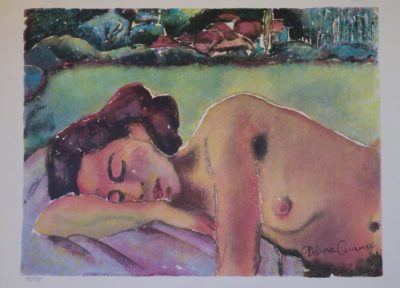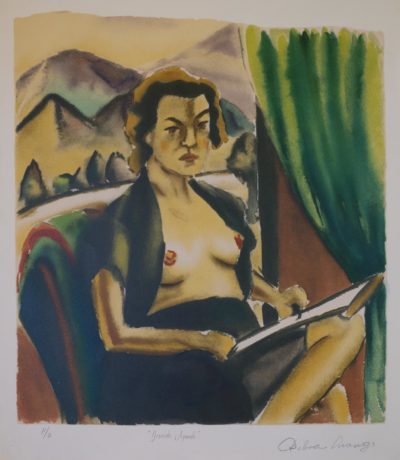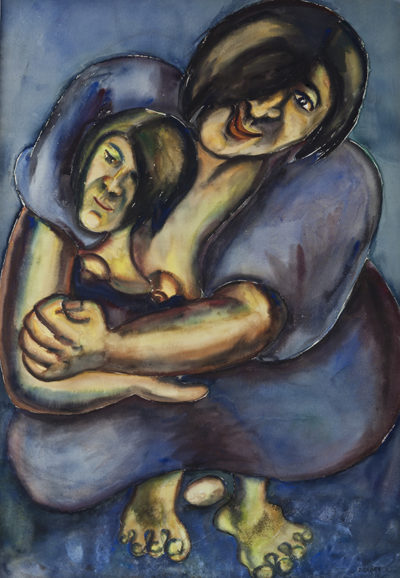
Arango painted this work in her thirties, and the model was one of her sisters. Traditionally, at that time, women artists’ access to femininity and the human body was mediated by the church, society, morals, medicine, laws, and so on, thus denying them female subjectivity. The female body was for the male gaze and pleasure. The notions of femininity and motherhood are social and cultural constructs that function differently in each society where the “feminine” is taken for granted. In works like Adolescence, 1939, Arango reversed the male gaze, taking control of the nude genre and female self-representation by portraying a woman’s nascent sensuality. The foreground is dominated by the sculpted legs, the upper body is covered by a red t-shirt, and her face is partially obscured by her arm, revealing her red lips. The various dynamic points within the picture plane produce an image that is simultaneously suggestive, intimate, and autonomous. The reclining body, crossed legs, half-open white flower and her lips denote innocence and blossoming femininity.
The MAMM Digital Collection is a work in progress. If you have additional information or have identified any errors, please contact us at [email protected].
If you would like to explore the contents of our collection further or access supplementary documentation, you can contact us at [email protected].