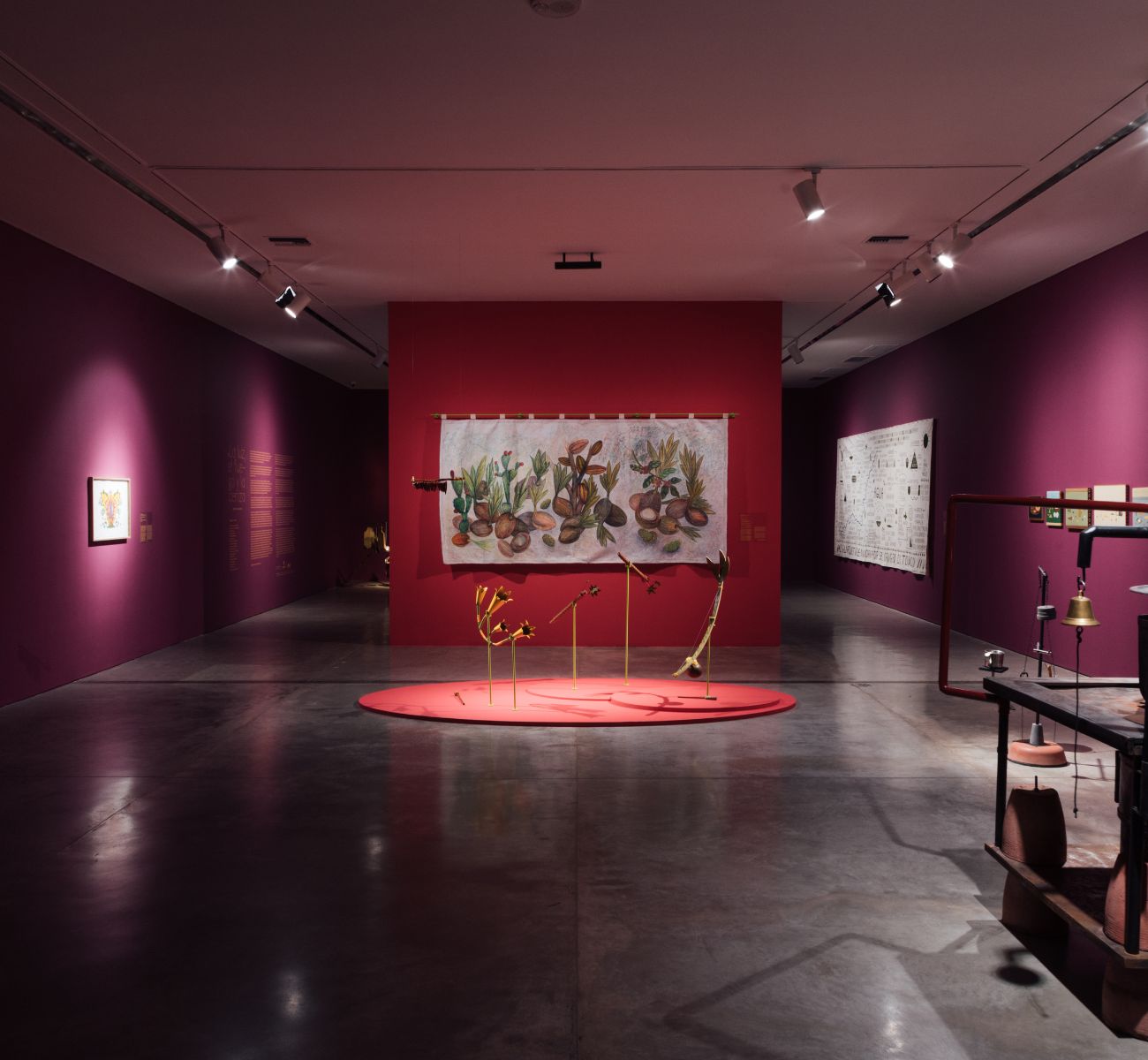
 From 26 of March 2026 to 09 of August of 2026
Artists: Alejandro Ramírez Restrepo, Anca Benera & Arnold Estefan, Carlos Alfonso, Carolina Caycedo, Christian Salablanca, Claudia Claremi, Ernesto Restrepo Morillo, Fabio Melecio Palacios, Jorge Julián Aristizábal, Las Nietas de Nonó, Manuel Correa y Marina Otero, María Buenaventura, Maritza Sánchez, Miguel Ángel Cárdenas, Sofía Olascoaga, Tatyana Zambrano, Vivien Sansour, Yuliana Bustamante Sosa.
Fire is the sun that allows sustenance to be cooked; we gather around it to converse, to conspire, and to weave a community. The Spanish word “hogar” (home) comes from “hoguera” (bonfire), the fire that nurtures and welcomes: communal pots provide sustenance, they are safe places for those who engage in processes of social and community resistance, while the mass production of foods—from the seed to the spoon—remains inextricable from extractive processes that impact the lives of people and ecosystems.
Ashes—the sun solidified, the remnants of a fire—fertilize the soil and strengthen the compost. They are transformed matter on its way back to the earth, to the deep interdependency among more-than-human beings and entities. We are all together a colossal bolus, permanently chewing, digesting, and excreting itself. As we eat and are eaten by others we uncover the myriad relational universes that shape our dwelling.
This project branches in two directions that nourish one another: an exhibitional component, located in Galleries B and C, and a live component, developed as a public program featuring performances inside and outside the museum, amplifying the practices of local agents—farmer’s markets, seed guardians, cooks, or urban gardens—and fostering spaces for exchange and collective learning. Here, the notions of nutrition and sustenance reach beyond the culinary to encompass other types of networks linking territories, economies, bodies, and memories.
From the mountains of the Aburrá valley, the high plains of Cundinamarca and Boyacá, the Caribbean islands, Costa Rican cuisine, the Romanian grasslands, the Spanish region of Almería, or the seed banks of Palestine, the exhibited works stem from situated practices that reflect on food systems functioning at multiple scales, including processes of territorial decay and transformation linked to the originally colonial economies that continue to prevail in contemporary food industries. What tensions and correspondences can be found between the local and the global in the realms of food production? What is the disproportionate impact of climate change, migration, and exploitation on food security and food sovereignty in what is known as the Global South? Migrations, territorial rootedness, interspecies collaborations, as well as eating and cooking as political practices of resistance and collective support, run through and spin the threads of this exhibition, which allows us to understand sustenance as a form of world-making.
Institutional Allies