

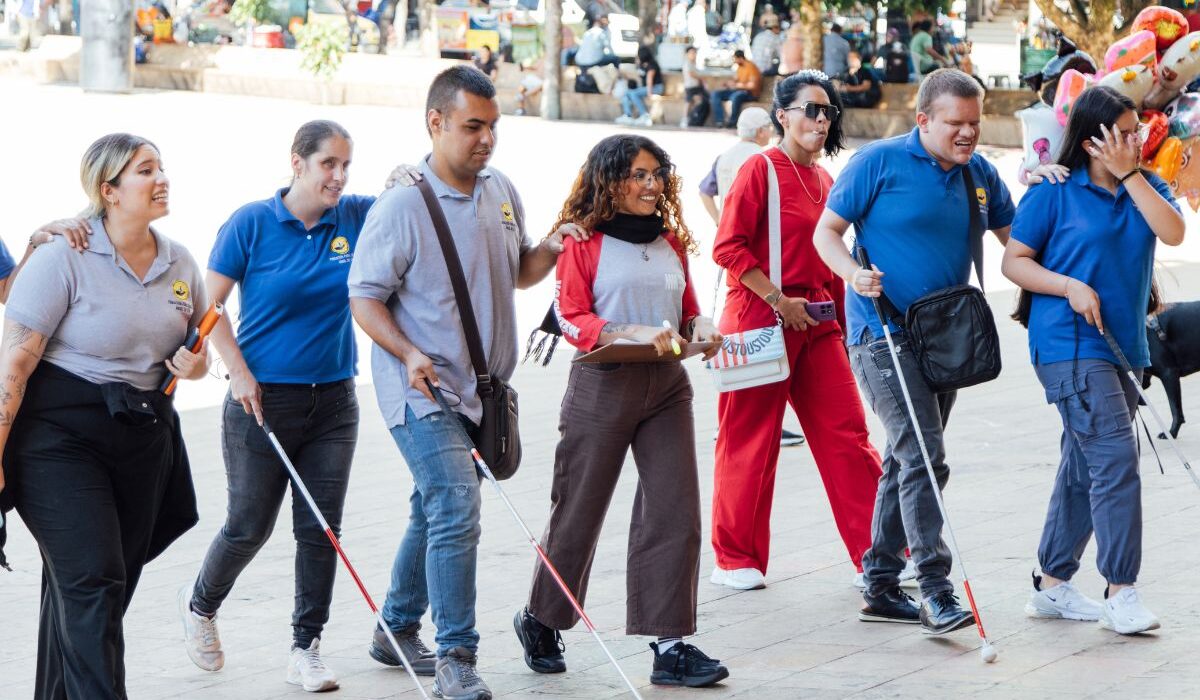
Habitar el Museo: a project to strengthen cultural accessibility in Medellín
The Museo de Arte Moderno de Medellín (MAMM) developed Habitar el Museo, a comprehensive cultural accessibility project aimed at people with visual disabilities—blind and low-vision individuals—carried out in partnership with the Fundación Sofía Pérez de Soto and thanks to the benefits for the promotion and strengthening of the museum sector from the Special District of Science, Technology, and Innovation of Medellín.
The initiative was conceived through co-creation, involving people with visual disabilities at every stage of the process. Their active participation ensured that the mediations, materials, and methodologies responded to real needs, promoting meaningful experiences for the participating audiences and strengthening the institutional capacities of the MAMM and the Casa Museo Pedro Nel Gómez, a partner museum in the project.


Three lines of action for comprehensive cultural accessibility
1. Training for museum teams
As a first phase, a training program in cultural accessibility and mediation was developed for the educational teams of the MAMM and the Museo Pedro Nel Gómez. The sessions were led by professionals with experience in art and accessibility, including a blind mediator from the MAMM, whose participation was key in guiding pertinent and sensitive practices.
The sessions included workshops on sensory accessibility, artwork description, use of tactile materials, and technical assistance for blind or low-vision audiences. A technical visit was also made to the partner museum, where the MAMM’s blind mediator offered direct feedback on descriptive clarity, sequence of stimuli, and application of tactile resources.
2. Cultural access for audiences with visual disabilities
The second line of action consisted of a public program of accessible mediated visits, which included transportation, refreshments, and specialized materials. The main component took place at the MAMM, but the accessible experience was also funded for 25 people at the Casa Museo Pedro Nel Gómez.
A total of 143 people participated, including attendees with visual disabilities and their companions. The activities combined natural materials, tactile replicas, soundscapes, tasting exercises, and spaces for collective dialogue, creating multisensory experiences designed for different age ranges.
In one of the sessions aimed at children, the mediation was structured as a narrative journey inspired by the “journey of water,” which strengthened cooperation and exchange between children with and without disabilities, promoting inclusive learning through experience.
3. Accessible cinema with Escuchar imágenes
As a third line, the project developed Escuchar imágenes, a pilot accessible cinema program with an emphasis on audio description and multisensory experiences, carried out within the framework of the Festival Audiovisual Miradas, a platform that highlights emerging talent in the film sector.
The feature film Mateo (2014), by Colombian filmmaker María Gamboa, was screened in a showing designed for blind or low-vision audiences. The screening included audio description and a post-screening conversation space led by the MAMM’s mediation team. 70 people participated in this experience, validating cinema as a powerful medium for activating listening, imagination, and multisensory awareness.
Partnerships for a more accessible city
Habitar el Museo was made possible thanks to the joint work with organizations working for the inclusion of people with visual disabilities: the Fundación para Ciegos Ángel de Luz, the Secretaría de Inclusión Social, the Parque Biblioteca de Belén, the Corporación Rehabilitar, and the Unión Antioqueña de Personas con Discapacidad Visual.
This project reaffirms the MAMM’s commitment to cultural accessibility as a right and to the construction of practices that open the museum to more ways of inhabiting it, feeling it, and experiencing it.