

In partnership with Universidad EAFIT, a course to take the pulse of cities arrives
Register for this Social Urbanism course starting July 10
How do we take the pulse of our cities? We partnered with the Centro de Estudios Urbanos y Ambientales – urbam – at Universidad EAFIT to offer a course on Social Urbanism from July 10 to 14, 2023, within the framework of the exhibition Medellín. Pulso de la ciudad, which was in our galleries from November 30, 2022, to April 9, 2023, and featured the participation of more than 20 artists and collectives from the city.
What is Social Urbanism?
The Social Urbanism strategy proposes a methodology of comprehensive approach to territories with social inclusion through the urban project as its premise. The implementation of this strategy in Medellín’s transformation process has turned the city into a laboratory for social, cultural, and urban transformation processes.
Since the late 2000s, Medellín has become a case study. People from around the world have sought answers to major urban challenges and have analyzed Social Urbanism as a formula due to the city’s evident transformation, with the goal of adapting and applying it in their own territories. However, upon studying the initiatives promoted in Medellín, they found more questions than answers; they discovered that Social Urbanism is not a magic formula, but a path that brings lessons and innovations, as well as challenges and issues still to be resolved.
About the course
Social Urbanism: How do we take the pulse of our cities?
This is proposed as a space for learning and dialogue around the tools, processes, and projects of Social Urbanism based on its values and achievements, but also its lessons and current urban challenges.
Study topics
- Comprehensive reading of the territory: elements for the construction of a city narrative.
- From housing to habitat.
- Processes and convergences: governance and innovation in management.
- The street: proximity, encounter, coexistence, and citizen security.
- Neighborhood and vicinity: environments of solidarity and impacts of tourism on the itineraries of daily life.
- Social Urbanism responsive to climate change.
Dates: July 10 to 14, 2023
Duration: 40 hours
Schedule: 8:00 a.m. to 12:00 p.m. and 2:00 p.m. to 6:00 p.m.
How will the course be conducted?
The course will be conducted in person, in two 4-hour blocks daily over one week. Through the course, participants will seek to discover, debate, and analyze the vital links between urban narratives and design as a transformative action.
The methodological approach of the course will be structured around three formats: master classes, workshops, and tours:
Master classes are settings in which professors present reflections and concepts on the topics addressed by Social Urbanism, through their experience and the analysis of concrete cases.
Workshops are practical spaces in which students are invited to reflect on the concepts, tools, and methodologies of Social Urbanism in close contexts and situations. This format is central to achieving a connection between the topics and the realities from which the students come, in addition to being a setting for validating learning outcomes.
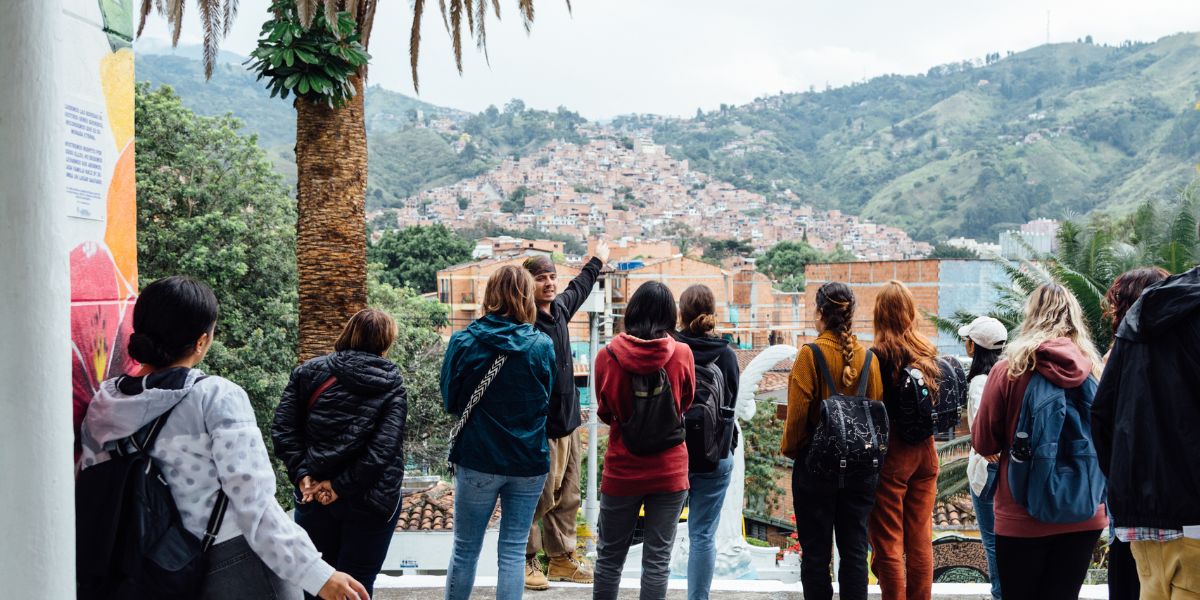
Tours are an experiential space in which students can observe the implementation of the Social Urbanism strategy by touring the city guided by key territorial actors, technicians, academics, and other experts who will lead an immersion into the neighborhoods, their dynamics, and their transformation processes.