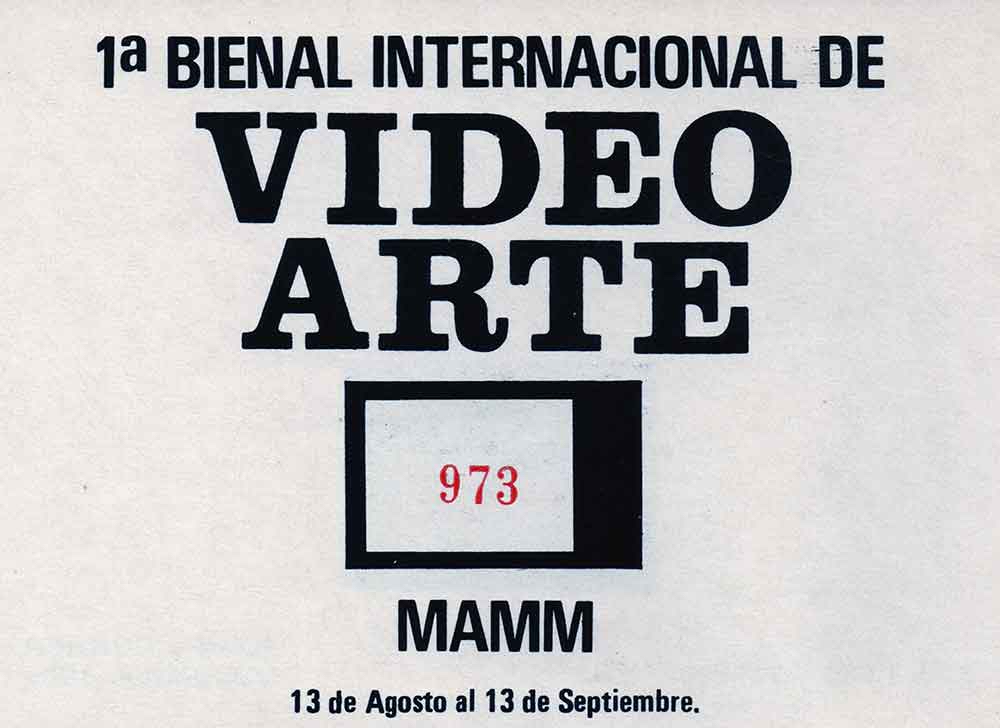
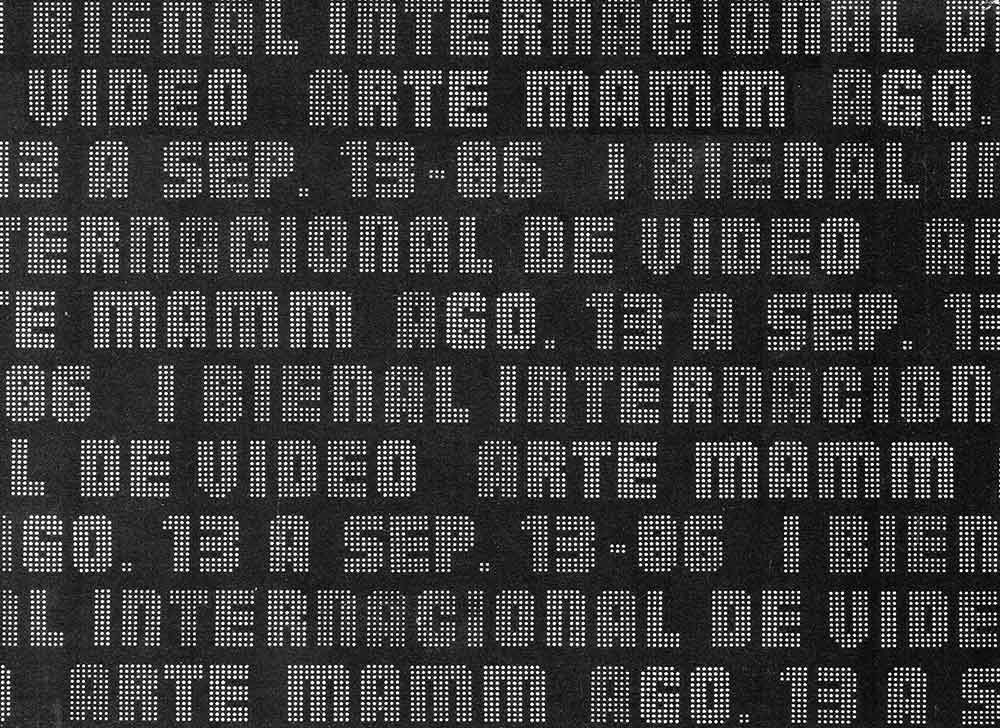
First Video Art Biennial
August 13 – September 13, 1986
Germany:
Ulrike Rosenbach, Mike Krebs, Herbert Wentscher, Ulay & Marina, V A Wölf, Klaus vom BRuch, Wolf Kahlen, Chris Newman, Nam June Paik, Ingo Günther, Barbara Hamman, Manfred P. Kage, Frank Soletti, Marcel Odenbach, Gruppe Notorische Reflexe, Norbert Meisner, Gabor Body.
Argentina:
Marie Orensanz, Margarita Paksa.
Canada:
Marc Paradis, Luc Bourdon, Francois Girard, Susan Reynard, Tanya MArs, Joe Sarahan.
Colombia:
Marta Vélez, John Jairo Correa, Gloria Tobón Múnera, Javier Cruz, Veronique Mondejar + Juan Guillermo Garcés + Dora Lucia Mejia + Olga Gaviria, Veronique Mondejar, Marta Elena Vélez, Juan Guillermo Garcés, José Alejandro Restrepo, Group A: Angélica Moreno + Luis Eduardo MAya + Alfonso Sánchez, Gilles Charalambos, Rodrigo Castaño, Carlos Viccente Uribem Ricardo Restrepo, Jonier Marín.
Chile:
Gloria Camiruaga, Ernesto Dittborn.
USA:
Julie Clucas, Heidi Klein, Don Little, Bridget Godfrey, Aileen Sovronsky.
France:
Pierre Lobstein, Dominique Belloir, Danielle Jaeggi, Robert Cahen, Yann N’Guyen Minh, Dominik Barbier, Richard Ugolini, Sophie Handshitterm Michel Jaffrenau & Patrick Bousquet, Teresa Wennberg, Catherine Ikam, Patrick Prado, Alain Jomier, Joan Longuet, Yves de Peretti.
Great Britain:
Mark Wilcox, LVA Production, Jeremy Welsh, Triple Vision, Tina Keane, Isaac Julien & Sankofa, Vulture Video, George Barber + Duvet Brothers + Gorilla Tapes, Mick Hartney, Alter Image.
Holland:
Leonie Bodeving, David García & Annie Wright, Jaap Druosteen, Michael Shabtay, Roos Theuws, Paul Müller & Anna Rubin, Lydia Schouten, Daniel Brun, Raúl Marroquín.
Japan:
Yasou Shinohara, Makato Saito, MAko Idemitsu, Toshio Matsumoto, Yoshinobu Kurokawa & Yohani Kibe, Shinsuke Ina.
Mexico:
Luis Fernando Camino.
Venezuela:
Ysabel Polar, Leonor Arraiz, Víctor Cadet, Nela Ochoa, Gustavo Morales.
–
II Video Art Biennial
August 31 – October 4, 1988
Germany:
Volker Anding, Gabor Body, Jean-Francois Guiton, Ingo Günther, Kain Karawahn, Norbert Meissner, Angela Melitopulos, Marcel Odenbach, Ulrike Rosenbach, Herbert Wentscer, VA Wölf.
Argentina:
Jorge Onehlia & Luis Martino, Gabriel Romano.
Brazil:
Tadeu Jungle, Vanderlei Schelbauer.
Canada:
Josette Belanger, Luc Bourdon, Chantal du Pont, Dominique Gaucher, Chris Mullington & Ed Eagan, Marc Paradis, Janette Reinhardt, Joe Sarahan, James Solkin.
Colombia:
Jorge Mario Vélez Arango, Juan Guillermo Arredondo, Elsa Borrero, Claudia Patricia Botero, Fernando Calero, Hugo Ceballos Córdoba, Confabularios -Video Group-, Gilles Charalambos, Javier Humberto Cruz, Victoria Eugenia García & María Adelaida Toro, Mariano González Gómez, Diego León Hoyos, Natalia Iartvski, Edgar Kiróz + León López + Alejandra Miranda, Luis Eduardo Maya, Luis Eduardo Mejía Duque, Veronique Mondejar, Jaime Muñoz, Luis Ospina, Pérez y Villa S.A., Esteban París Londoño, Pablo Hernando Parra Susana, Jorge Luis Pérez Valencia, José Alejandro Restrepo, Eduardo Restrepo Díaz & Jairo Valderrama, Gloria Restrepo Saldarriaga, Carlos Augusto Vélez Vásquez, Juan Alfredo Uribe Cardoso, Carlos V. Uribe, Clara Inés Restrepo, Patricia Cañas, Luis Miguel Mejía, Carlos Herrera Carlos Acosta, Carlos Mendoza, Esmeralda Bedoya, Gustavo Arango, Gustavo Rizo, Beatriz Guircel, Sandra Carvajal, Olga Puerta, Sara Jaramillo, Lina Escobar, Sergio Velásquez, Felipe Echavarría, Juan David Correa.
Cuba:
Luis Miguel Valdés
Chile:
Teleanálisis Collective, Gloria Camiruaga, Lotty Rosenfeld.
Spain:
G. Collins + F. García + J. Piris.
USA:
Arne Bro, Kate Horsfield & Nereyda Garcia, Carlos Díaz, Carlos Terrazas, David A. Clark, Robert Hamilton, Tom Kalin, Efstathios Lagoudakis, Valerie Soe, Peer Bode, Cecilia Condit, Juan Downey, Matthew Geller, Shalom Gorewitz, John Knecht, Ardele Lister, Donna MAtorin, John Orentlicher, Carol Porter, Daniel Reeves, Michael Schell, Kim SMith, Bill Viola, Reynold Weidenaar, Edward Zajec.
France:
Carine Asscher, Dominik Barbier, Henri Bassmadjian & Yves de Peretti, Dominique Belloir, MAurice Benayoun, Veronique Brenton, Robert Cahen + Stéphane Huter + Alain Longuet, Marc Caro, Elsa Cayo, Sonia Cauvin, Philippe Collin, Paul Chamussy, Frédéric Martin & Frédéric Develay, Jean-Marie Duhard & Richard Ugolini, Jean-Paul Fargier & Georges Rucki, Larry Flash, Patrick de Geetere, Alain Guesnier, Marc Guerini + Edith Grattery + Regis Didry, Michel Jaffrennou, Daniel Larrieu & Jean-Louis le Tacon, Pierre Lobstein, Xavier Moehr, Claude Mourieras, Yann Nguyen Minh, Marcel Odenbach, Gilles PAsquier, Jean-Bernard Pouchous, Patrick Prado, Claude Rey, Michel Schneider.
Great Britain:
Sera Forneaux, Sven Harding, Peter Harvey, Isaac Julien, Chris Meigh Andrews, Katharine Meynell, Liz Power, Simon Robertshaw, Janus Scerek, Atalia Shaw, Marion Urch, Jeremy Welsh, Jonnie Turpie.
Holland:
Rob Mariauw Smit, Han van Gelder, Bert Haanstram Paul Hut, Polygaah, R. Hock.
Italy:
Istituto della Enciclopedia Italiana.
Japan:
Iwao Banno & Masaru Ohashi, Akira Hasegawa, Visual Brains: Sei Kazama & Hatsune Otsu, Shinsuke Ina, Mako Idemitsu, Hiroki Suzuki, Koichi Tabata, Seiko Otobe, Toshio Yasuda.
Mexico:
Luis Fernando Camino.
Paraguay:
Clement Padin.
Venezuela:
Sammy Cucher, Nela Ochoa.
–
III BiennialVideoart
August 15 – September 27, 1990
Germany:
Ernst Jurgens, Walter Smerling, Film Workshop E.V.
Argentina:
Andrés Di Tella, Fabián Hoffman, Carlos Trilnick.
Brazil:
Adriano Goldman, Renato Barbieri, Paulo Morelli, Roberto Salatini, Edson Eugenio Deoclecia Teixeira, Eder Santos, Lucila MEirelles, Rafael Franca, Sandra Kogut, Rita Moreira, Piche Martirani.
Canada:
Chantal Dupont, Chris Mullington, Marc Paradis, Michelle Desaulniers, Katharine Liberovskaya, Josette Bélanger, Francois Girard & Raymond Saint-Jean, Daniel Dion.
Colombia:
María Isabel Restrepo, Carlos V. Uribe, Suzanne Mitus, Alejandro Castillo, Elbert Valderrama, Sergio Ramírez, Confabularios -Video Group-, Juan Fernando Franco, Omaira Abadia, Fabio David Franco, John Jairo Restrepo, Carlos F. Rodríguez, Javier Cruz, Ana Claudia Múnera, José Manuel Valdés, Dora Lucia Mejía, Johan Rausch Restrepo, Colectivo Universal Nal, Mauricio Cuartas, Manuel Guerrero Mora, Esmeralda Bedoya, Margarita Becerra Cano, Jimy Orlando Irreño, Patricia Bravo, Carlos Echeverry, Carlos Bernal, Eduardo Restrepo & Jairo Valderrama, Luis Ospina, José Antonio Dorado, Claudia Lucía Alvarez, Diego Morales Parra, Raúl Blanco, Eduardo Carvajal & Elsa Vásquez, Diego Carrizosa, Veronica Mondejar, Seduca.
Chili:
Nueva Imagen Ltda., Alejandro Contreras, Gloria Camiruaga, Lotty Rosenfeld.
USA:
Michael Smith, John Sanborn, John Orentlicher.
France:
GOES.
Great Britain:
GOES.
Holland:
GOES.
Hungary:
GOES.
Italy:
Brother Olmmi, Carlo Lizzani.
Israel:
Yigal Lussin.
Japan:
Mako Idemitsu, Yo Nakajima, Kanji Nakajima, Masaru Tanaka, Visual Brains.
Mexico:
Luis Fernando Camino, Alvino Alvarez, Irma Ávila Pietrasanta, Ramón Cervantes Agudelo, Carlos Cruz Barrera, Oscar Méndez Zavala, César Sandoval, Daniel Touron Sala, Leticia Villavicencio, Manuel Martínez.
Swiss:
Hans Peter Ammann, Enrique & Fernando Fontanilles, Simon Lamuniere, Anna Winterer, Muda Mathis, Andrea Iten.
Uruguay:
Julio Gadé & José Claudio F., Clemente Padín, Roberto Mascaró.
Venezuela:
Leonor Arraiz, Nela Ochoa, Oscar Molinari Herrera, José Antonio Hernández.
–
IV Video Art Biennial
September 23 – October 23, 1992
Argentina:
Marcelo Laccarina & Gonzalo Pampin, Diego Lascano, Carlos Trilnick, Pablo Rodríguez Jaure, Sabrina Farji, Andres Di Tella & Fabian Hoffman, AR Detroy.
Brazil:
Mario Diamante, Lucila Meirelles, T.V. Long live Olinda.
Colombia:
Luis Ospina, Gabriel Viera & William Villa, Fredy Gonzalez Zubiria, Carlos Arturo Ángel, Gabriel Guevara Peña, Felipe Paz, Margarita Carrillo, Juan Guillermo Garcés, Álvaro Tangarife, Ana Claudia Múnera, Carlos Echeverry, Gonzalo Chacón & Gilles Charalambos, Luis Morales, Carlos Alberto Suárez, Dora Lucia Mejía, Clara Inés Restrepo, Oscar Botero Giraldo.
Cuba:
Raysa White.
Chile:
Gloria Camiruaga & Lotty Rosenfeld.
USA:
John Orentlicher, Jorge Farre Diaz & Ruben García, Diane Nerwen Les Leveque, Tom Sherman & Jean Piche, Todd Coberly, John Knecht, Donald Little, Margarita Becerra Cano, Grupo X.
France:
Robert Cahen, Yves de Peretti, Pierre Lobstein, Patrick Prado, Dragaba Zarevac, Christian Boustani, Jean-Baptiste Mathieu & Gérard Boch, Dominique Belloir, Eve Ramboz.
Great Britain:
Duggie Fields, John Giorno, Jim Whiting, Robyn Beecherm Julianm Opie, Maasia, Sankai Juko, Flying Lizards, Piers Gouch, Three Gorgette.
Hungary:
Elemer Csak & Peter Kiss, Domolky Janos, Baloga Zsolt.
Italy:
Folco Quilici, Massimo Becattini, Comone Di Firenze, Giancarlo Governi & Leoncarlo Settimelli, Alberto Di Cinto.
Japan:
Atsushi Ogata.
Mexico:
Rafael Rebollar, Antonio Noyola, Francisco Urrusti, Rafael Montero, Luis Dupone.
Panama:
Gerardo Maloney, Sandra Eleta, Marina Gutiérrez, Jorge Luis Cajar.
Paraguay:
Juan Carlos Maneglia.
Swiss:
Pipilotti Rist, Eric Lanz, Muda Mathis & Renatus Z. Urcher, Alexander Hahn, Marie Jose Burki.
Venezuela:
Nan González, José Velasco, Lino Roa.