

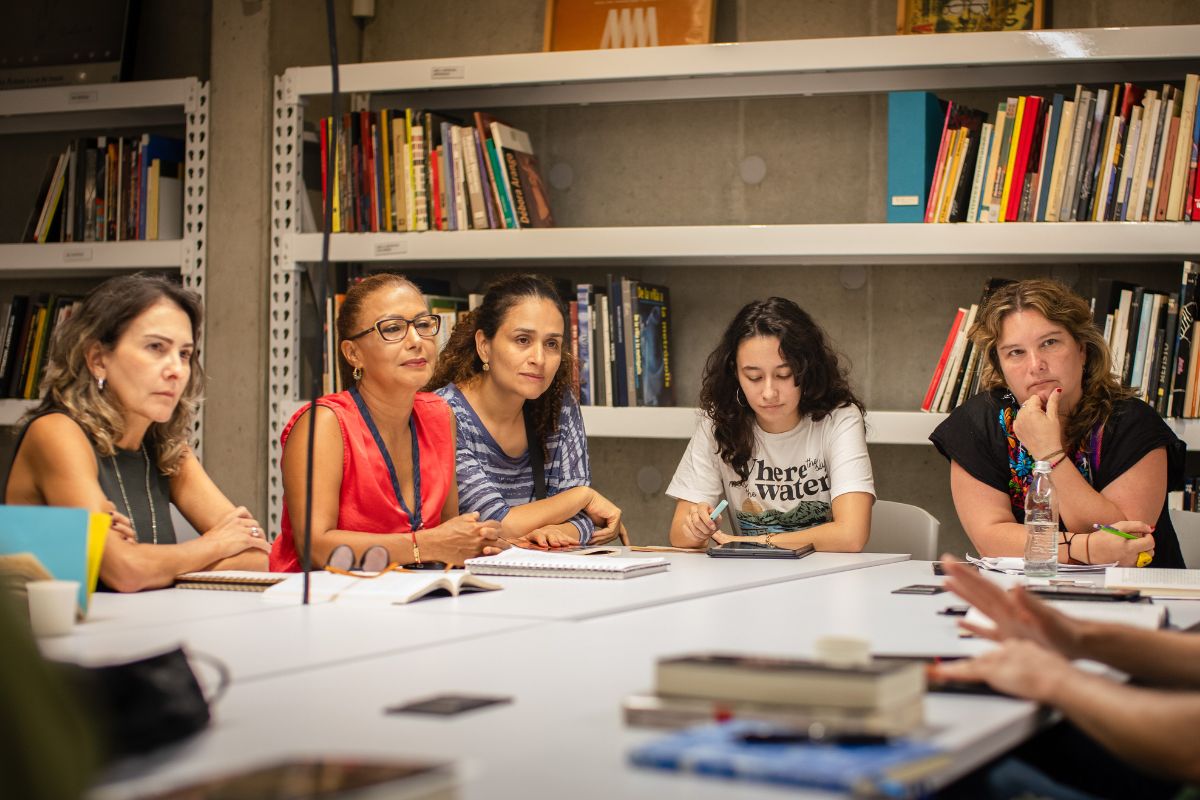
Art and Literature Reading Club
INSCRIPCIONES CERRADAS
Start date: Tuesday, February 4, 2025
Time: 5:00 p.m. to 6:30 p.m.
Format: In-person
Venue: Study Room
Aimed at: People interested in shared reading
Fee: $230,000 COP (Annual, includes unlimited Museum admission, 20% discount on MAMM Store own products)
MAMM Friends discounts: Essential $184,000 COP / Close $172,500 COP / Benefactor $161,000 COP
Meetings will take place weekly, on Tuesdays at 5:00 p.m. Throughout the year, approximately seven books are read.
Explore some of the selected authors and titles. We suggest not purchasing all the material at once, as the reading plan may be adjusted based on conversations with club members.
Year 1596, Stratford-upon-Avon, England. Agnes’s life passes peacefully alongside her husband and their three children. She cultivates medicinal plants while William works in London. Fate, however, has a harsh blow in store for them when their eleven-year-old son Hamnet dies suddenly after contracting the plague. In the wake of this tragedy, his father will create one of the great characters of universal literature, with a name almost identical to his son’s. But this book does not speak of famous events but of something intimate and forgotten: the life of this family, and especially of the woman who held it together and had to bear an unbearable loss. In her new novel, enormously successful and which earned her the prestigious Women’s Prize for Fiction, Maggie O’Farrell moves between fiction and historical reality to bring us closer to the past from another point of view and vindicate one of those unforgettable figures who, like Agnes, populate the margins of history. O’Farrell meticulously transports us to the everyday life of the English countryside at the end of the sixteenth century and delves into the small yet great questions of an ordinary existence: motherhood, marriage, grief, and loss.
“I realized that understanding Feliza was a difficult undertaking. Nothing was simple when it came to her.”
On January 8, 1982, the Colombian sculptor Feliza Bursztyn died in a restaurant in Paris. She was forty-eight years old. At the moment of her sudden death, she was accompanied by her husband and four friends. One of them, the writer Gabriel Garcia Marquez, published an article days later that included three seemingly simple but deeply mysterious words: “She died of sadness.”
Juan Gabriel Vasquez starts from those words to investigate the secret or unknown life of an extraordinary woman. Feliza Bursztyn always confronted the society in which she had to live. Daughter of a Jewish couple expatriated in Colombia, a revolutionary artist in a time of political revolutions, a free-spirited woman in a world that distrusted women’s freedom, she led an existence that staged the great tensions of the 20th century and, above all, the desire to be master of herself.
In Los nombres de Feliza, the author masterfully fuses autobiography, reality, and imagination to deliver to the reader an astonishing and heartbreaking fiction about how the intimate life of a human being is inevitably overwhelmed by the forces of history and politics.
When he was twelve years old, Cosimo Piovasco, Baron of Rondo, in an act of rebellion against the rigid family discipline, climbed a holm oak in the garden of his family home. That same day, June 15, 1767, he met the daughter of the Marquises of Ondariva and announced his intention to never come down from the trees. From then on and until the end of his life, Cosimo remains faithful to that principle. From the late 18th century to the dawn of the 19th, the baron participates in both the French Revolution and the Napoleonic invasions, but without ever abandoning that necessary distance that allows him to be inside and outside of things at the same time. In this splendid work, a true adventure novel brimming with poetic and fantastical humor, Calvino confronts what he himself declared to be his true narrative theme: “A person voluntarily sets a difficult rule for himself and follows it to its ultimate consequences, since without it he would not be himself either for himself or for others.”
One night, during his stay in Buenos Aires for the filming of his movie Tetro, Francis Ford Coppola told Maria Gainza: “The artist comes into the world with a quiver containing a limited number of golden arrows. He can shoot all his arrows when young, or shoot them as an adult, or even when old. He can also shoot them little by little, spaced out over the years. That would be ideal, but you know that the ideal is the enemy of the good.”
In addition to Coppola, in Un punado de flechas there appear a Cezanne watercolor stolen from a museum in Buenos Aires, a collector’s house, a walk through Thoreau’s Walden Pond, the enigmatic paintings by Bodhi Wind of California swimming pools that appeared in the no less enigmatic Tres mujeres by Robert Altman, the oils of the Catalan painter Nicolas Rubio in which he evoked the French village where he spent the Spanish Civil War, the cosmopolitan life and memory of the sculptor Maria Simon, the adventures of the painter Francis Hopkinson and his assistant Moon in Mexico, and a cursed Titian painting hidden in Tzintzuntzan…
Halfway between essay and narrative, Maria Gainza continues to explore new ways of understanding writing, breaking the watertight barriers between genres. A book in which art, literature, and life intersect, confirming its author as one of the most stimulating voices in the current landscape of Spanish-language literature.
Myriam, a mother of two children, decides to resume her career at a law firm despite her husband’s reluctance. After a thorough selection process to find a nanny, they settle on Louise, who quickly wins the children’s hearts and becomes an indispensable figure in the household. But little by little, the trap of interdependence turns into a drama. With a direct, incisive and at times dark style, Leila Slimani unfolds a disturbing thriller where, through the characters, the problems of today’s society are revealed — its conception of love and education, of submission and money, of class and cultural prejudices. Canción dulce won the Prix Goncourt 2016.
Fifty-two weeks: that is the time Mona, a ten-year-old girl, has to treasure all the beauty of the world. It is the span her erudite and original grandfather has given himself to reveal to her, every Wednesday after school, a work of art before she goes blind. Together, they set out to visit the three great Parisian museums: the Louvre, the Orsay and the Beaubourg (Centre Pompidou), and to immerse themselves in paintings and sculptures so that their beauty and philosophical meaning may permeate and inscribe themselves forever deep within Mona. Looking through the eyes of Botticelli, Vermeer, Goya, Frida Kahlo or Basquiat, the little girl will learn about generosity, doubt, melancholy, autonomy or indignation, and will incorporate their powerful teachings into her daily life.
“The village of Holcomb stands on the high wheat plains of western Kansas, a lonesome area that other Kansans call ‘out there’…” From this precise location, Truman Capote captures the reader in a gripping story and inaugurates, as he himself proclaimed, a genre. The story is that of the four members of the Clutter family, savagely murdered in their home, a tragedy intertwined with the execution of Dick Hickock and Perry Smith, five years, four months and nineteen days later. The genre: the “nonfiction novel,” a brilliant combination of the key elements of the writer’s and the journalist’s crafts.