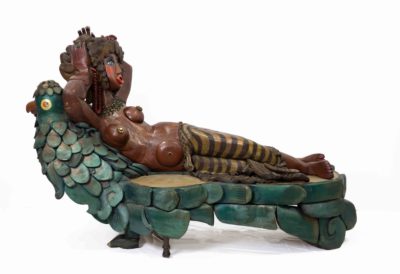
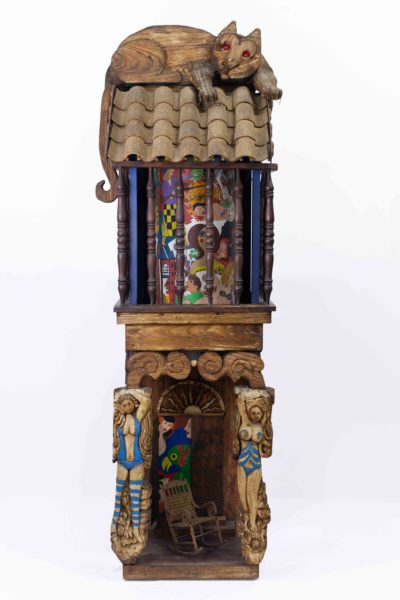
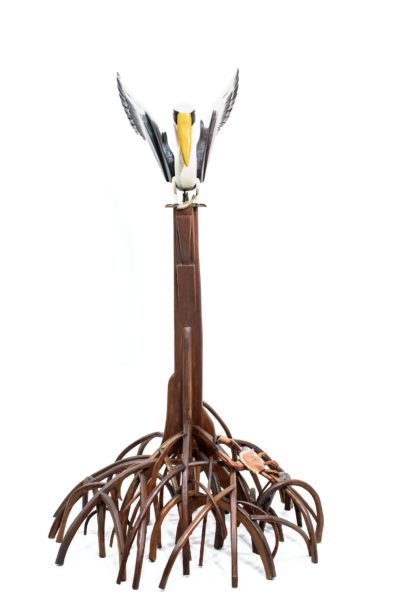
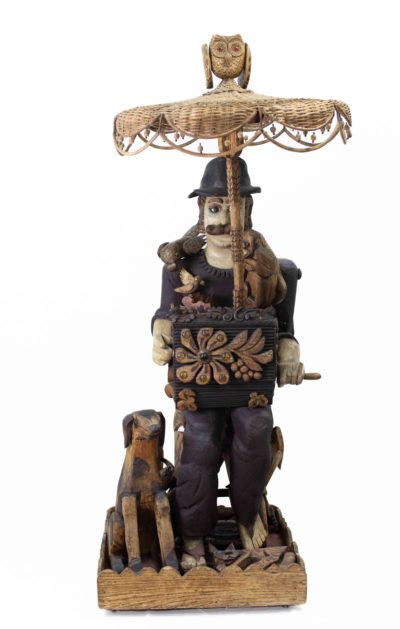
In the 1970s, Cali became a hotbed of artistic experimentation. By then, the city offered an ideal niche for the emergence of new ideas, movements, and cultural venues. Prominent artists such as Enrique Grau, David Manzur, Antonio Roda, Pedro Alcántara Herrán, Lucy Tejada, and Hernando Tejada, inspired by the renewal that a living, community-based, and dynamic art implied, found in places like the Teatro Experimental de Cali (1955|1969) and Ciudad Solar (1971) stages to explore their concerns, to question the scope of artistic disciplines, and to germinate the seed of Cali’s counterculture. In that environment, and having already made all sorts of artifacts, puppets, and sets for theater, ballet, and opera, Tejada set out on an even more challenging endeavor: “I am going to make object-women,” he declared to his friend, the dancer and cultural manager Larissa Sanclemente, who was also the proud owner of the red mesh stockings worn by Mónica, the philharmonic woman (1976). Mónica, like the other object-women, had a functionality — in this case fundamental to Tejada’s everyday life — that of safeguarding his record player and his numerous acetate records and vinyls. Although Mónica has a close relationship with music and even participated in events with the Cali Philharmonic Orchestra, she would not be the only wooden piece dedicated to this discipline; after her came the record holders Bach, Beethoven, Schubert, Satchmo (1975-1976) and pieces like the Organ Grinder (1976).
The MAMM Digital Collection is a work in progress. If you have additional information or have identified any errors, please contact us at [email protected].
If you would like to explore the contents of our collection further or access supplementary documentation, you can contact us at [email protected].