 Gallerie D
 From 10 of September 2026 to 28 of March of 2027
Artista: Astrid González
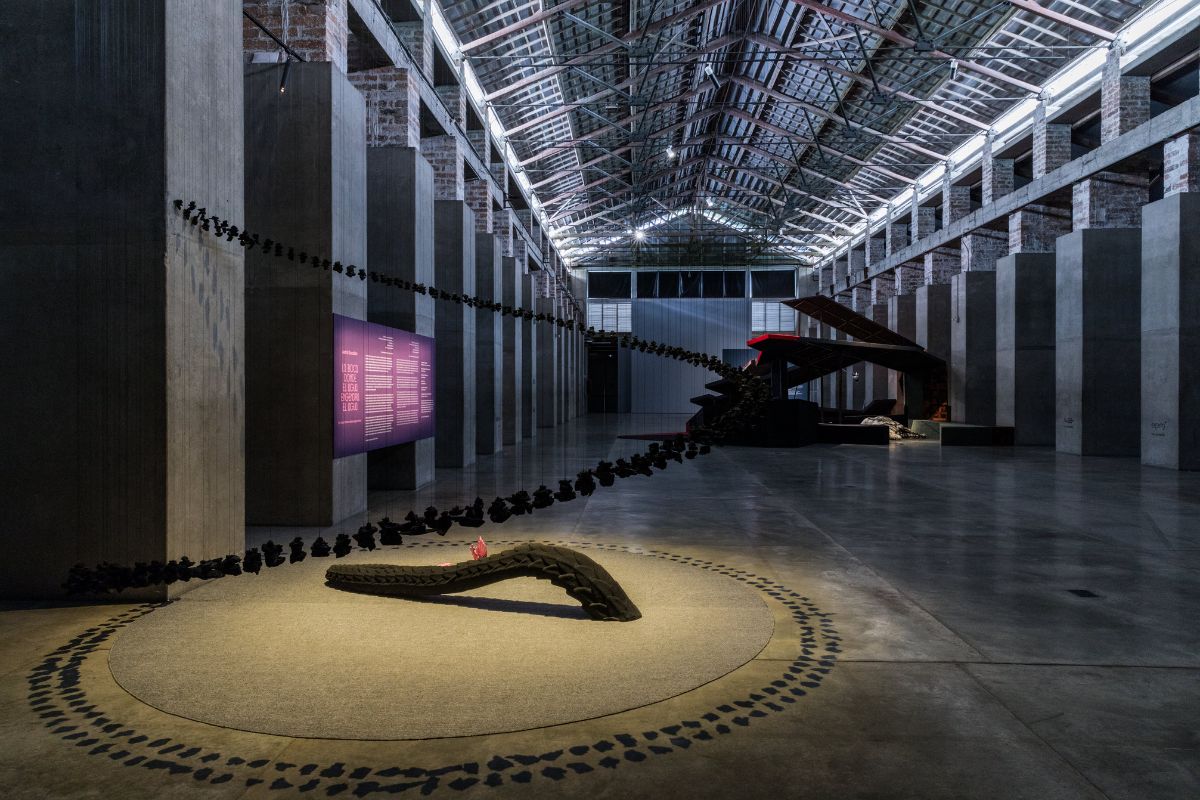
The bottom of the sea remains a mystery. Scientists often use the adjective “dark” to describe something whose nature they do not understand yet: “dark matter,” “dark energy.” Paradoxically, we know less about the oceanic depths than we do about some regions of outer space. Thus, “darkness” does not designate an absence, but rather the limit of Western knowledge; this limit marks the inception of the territory explored by Black thought, a territory of refuge, resistance, and autonomy.
As a result of the transatlantic trade of enslaved people from the sixteenth to the nineteenth century, for many Black thinkers the ocean is both a cemetery and a land of liberation. Its darkness is not solely an absence of knowledge, as it is for the Western gaze, but an opaque geography articulated in a ciphered language—the cimarrón language—, that of the time it takes a body to become carbon within salty waters.
From this perspective, Astrid with others examine the density of opaque waters to bring us towards another space, suspended between imagination and memory: an underworld populated by water spirits whose forms of existence escape the narrow frameworks of reason. This is the site of a fabulation in which sirens, snakes, and the beings of Haitian vodou open the way to other sensory regimes: listening to dreams, reading the currents, presaging the rain, traversing death, and sensing the vibrations of ancestors lying in the sea depths.
These waters are stages for radical imagination, where the remaining time of drowned bodies opens conversations about curing Alzheimer’s with poisonous flowers, the cimarrón materiality of carbon, Haitian snakes, and the Colombian Pacific’s mother water. In these deep geographies, coding strategies are created to protect Afrodescendent epistemes from colonial pupils. Guarded by ancestral presences, this traffic follows invisible streams that lead beyond life and death, where water engenders water.
Institutional Partnerships
Support provided by