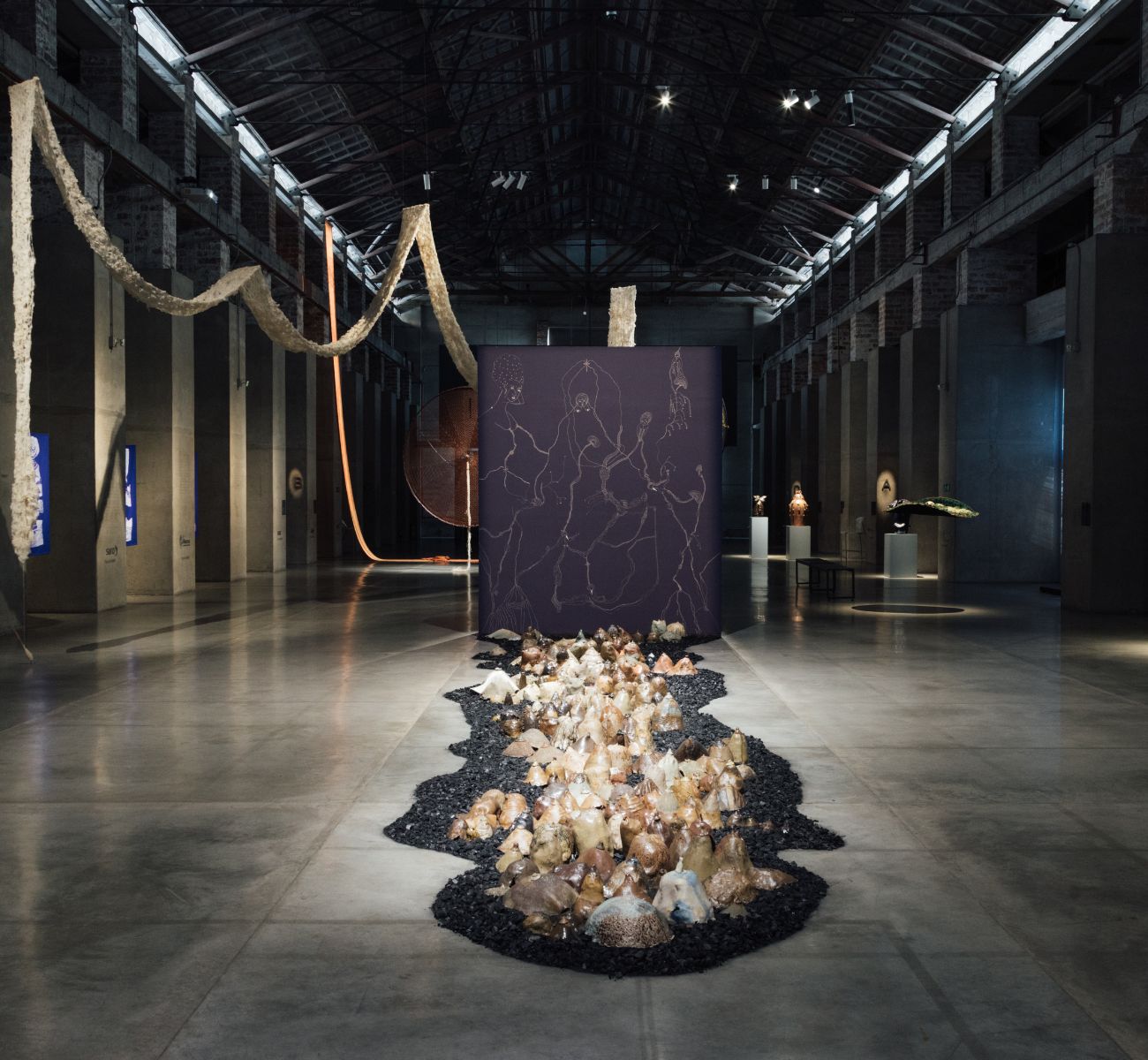
 From 26 of March 2026 to 09 of August of 2026
Artists: Ad Minoliti, Adriana Roldán, Álvaro Barrios, Ana Mendieta, Asicaz Monzón, Beatriz González, Carlos Motta, Carolina Caycedo, Débora Arango, Eblin Grueso, Emma Reyes, Ethel Gilmour, Germán Alonso García, Hernando Tejada, Jonathas da Andrade, Juliana Góngora, Julieth Morales, Libia Posada, Luz Ángela Lizarazo, María Cristina Cortés, María Roldán, Marta Elena Vélez, Nina Squires, Óscar Muñoz, Paloma Contreras Lomas, Pablo González, Lucy Tejada Saénz
It seems fair to say that the crises of our time have been caused by self-imposed hierarchies of some humans over others and of the human species over other forms of existence; these are the sources of racism, sexism, extractivism, and various forms of oppression. In response, many social movements, including Latin American feminisms, have called for a struggle against all forms of violence—especially those that target local territories. These movements understand that the liberation of women—and of other feminized corporealities—cannot be achieved separately from a liberation of the planet; their struggles consider the body as the first territory of defense.
The title We Are Inhabited by Birds and Mountains, inspired by the words of Lygia Clark, suggests that bodies are traversed by natural, symbolic, and more-than-human dimensions that enable the coexistence of a plurality of beings and contradictions. The exhibition works around the concept of the body-territory, staging an intergenerational dialogue between works from the MAMM’s collection and the practices of local contemporary artists. The connection between body and territory is understood here as creating a space for identity, memory, re-existence, and debate.
As the exhibition unfolds, landscapes become characters and territories become bodies. The works evoke corporealities permeated by histories, materialities, violences, and resistance, by the mystical, desire, and the emotions. Among mountain ranges, clouds, palm trees, mangroves, and rivers, many-headed totems guard, protect, and guide the exhibition, caring for the memory of a forest for which they were created and which has now vanished.
The works in Gallery A trace three conceptual axes, named after three works by Débora Arango. The first axis, Montañas (Mountains), explores the symbiosis of body and landscape, which steers hegemonic forms towards other ways of being. The second axis, Adolescencia (Adolescence), explores sensuality as an act of re-existence and resistance to censorship. The third axis, Friné, exposes feminized corporealities as disputed territories. This three-fold narrative is expanded by pedagogic and performative components. During the exhibition, Gallery D will be taken over by the Feminist School of Painting, a project by Ad Minoliti that endeavors to rethink painting from a feminist and collective perspective.
The exhibition as a whole is conceived as an invitation to reflect on the body-territory as a permeable realm, a realm of transformations that questions the separateness of humanity from other forms of existence, hierarchical dualisms, and the individual/collective dichotomy. If we blur these limits we can imagine other, kinder ways to inhabit.
Institutional Allies