

How to create impossible spaces?
Museographic dialogue with the Art as Education Residency
The Art as Education Residency is a project by SOA Arte Contemporáneo and ACE (Art as Education), whose second edition was held in Medellín between September and October 2022, in partnership with the Museo de Arte Moderno de Medellín and the COMFAMA school network, Cosmo Schools, with the support of ISLAA, the Institute for Studies on Latin American Art.
In both of its editions, the Art as Education Residency has been a space for collective work that seeks to apply the cross-cutting thinking of artistic practice in the educational field. It has also proposed opening reflections on how artistic thinking can be a pathway for questioning the world and how the questioning inherent in creative processes can be applied within the educational and professional spheres, and for life.
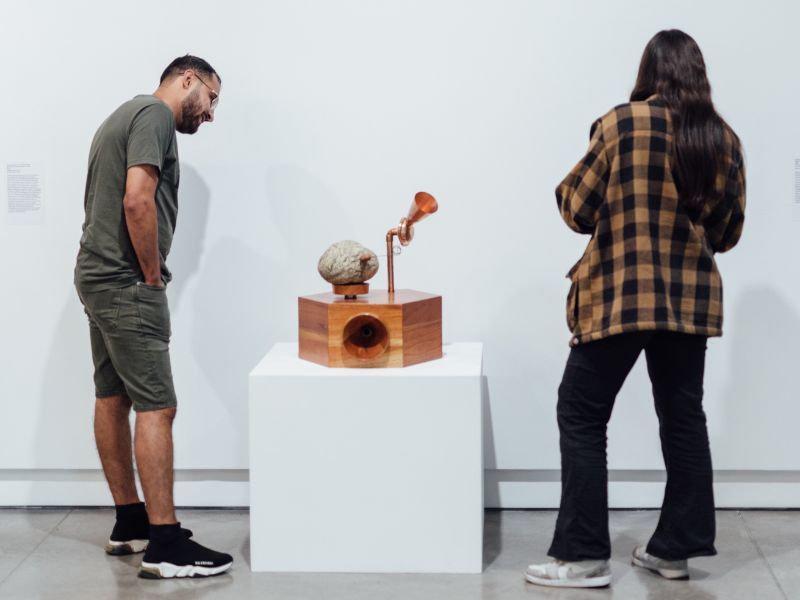
As part of the results of this residency, a museographic dialogue has been generated between the Museum space, five works from the exhibition Versión libre. Sucesos en la colección MAMM, and the questions these generated during the Art as Education Residency.
How can we reintroduce impossibility and the unpredictable into the educational process to encourage the development of a limitless imagination? In recent centuries, education has increasingly focused on the concept of utility and applicability to satisfy the labor market. The tendency to promote STEM courses (science, technology, engineering, and mathematics) to the detriment of the Humanities makes us fear an abandonment of creative imagination for the average citizen. Without denying the importance of practical aspects and the need to find employment, we are concerned about the effects that a limitation of cognitive processes has on a society where consumption already predominates over creation.
The speculative intention that, in addition to broadening the reading of the world, exercises and expresses the imaginative and utopian dimension, allows for the construction of a platform from which the reality of what is possible can be critically evaluated. This critical distance helps identify the obstacles that separate impossibility from the possible, the obstacles that cause impossibility, and the analysis of the interests and power structures that benefit from their presence. It thus facilitates negotiation with reality in a transdisciplinary and creative manner to expand the field of the possible in service of the common good. It accepts the poetic as an important part of our daily life. This methodology is typical of artistic practice, but is generally assumed to be reserved for a few as the product of a specialization that separates the professional artist dedicated to succeeding on a meritocratic scale from the average citizen.
We believe that part of traditional education has become training. Projects like the Art as Education Residency seek to redefine education to help in the exploration of creativity with the purpose of enriching the acquisition and processing of information, promoting the generation of new meanings, and defining good citizenship as an act of continuous creation beyond the specific competence needed for a particular profession or job. That is why the residency proposes integrating artistic methodology across all disciplines, regardless of their content, as a way of perceiving and changing boundaries, of problematizing reality, as a technique of questioning and reordering, and of inscribing creativity in all fields of knowledge.
To achieve these changes, it is essential that museum visitors actively participate in the same creative process used by artists, rather than continuing with exercises that only involve “art appreciation.” Through exercises and dialogues related to the questions generated by the artworks in the MAMM Collection, we try to lead the public to find their own answers. In doing so, people enter the process of critical and creative thinking inherent in artistic practice, act as colleagues of the artists rather than consumers, and avoid becoming prematurely entangled with questions of taste. By understanding the thinking process needed to solve problems and answer questions, the visitor understands the importance of problematization and of questions that allow for greater reflective depth. These aptitudes and attitudes are as necessary in art as they are in science or any other discipline used for the acquisition, processing, and expansion of knowledge. Therefore, art presented in this way is not an end in itself, but a metaphor and a field of experimentation.
37 Cosmo Schools mentors, 8 Colombian artists, and 5 MAMM mediators participated in the Art as Education Residency.
SOA / ACE Team: Ana Gotta, Luis Camnitzer, María Del Carmen González, Marina García López, Sofía Quirós, Vivian Honigsberg.
SOA arte contemporáneo is an independent Uruguayan contemporary art collective that works in curatorship and production of projects, and ACE (Art as Education) is an international collective based in New York that understands “art” as a flexible way of thinking not limited by disciplines—that is, as a meta-discipline, applicable to all teaching and learning processes.
Resident artists and mediators: Andrea Ospina Santamaría, Andrés Vergara Bonilla, Angélica Teuta, Juan Camilo Carmona Bedoya, Daniel Serna Henao, Emiliano Cano Arias, Georgina Montoya Vargas, Isabella Ramírez Balthazar, Johana Gallego Lezcano, Jorge William Agudelo Muñetón, Juan Camilo Londoño Manco, María Verónica Machado Penso, Natalia López Polanía, Yuliana Ocampo Henao.
Cosmo Schools mentors and COMFAMA team: Amalia Yanuba Vega Quiñones, Angie Katerine Carmona Suárez, Anny Leandra Quiroz Ospina, Carolina Marín Castaño, Claudia Lucia Cartagena Montoya, Cristina Ospina Villa, Dahiana Caro Taborda, Daniel Ortega Sanmartín, Daniel Sepúlveda Guarín, Daniela Alejandra Pinillos Hernández, Diana Patricia Arroyave Hernández, Gina Daniela Parra López, Jorge Andrés Londoño Ceballos, Juan Esteban Vélez Bolívar, Juliana Roldán Chica, Karen Dayana Patiño Castaño, Leidy Johana Ramírez Jiménez, Lina Marcela Cuartas Villa, Lucía Martínez Castellanos, María Camila Gómez Montoya, Maria Camila Vega Vélez, Mariana Bustamante Gómez, Maroly Cortés, Mateo Maya Torres, Mike Yerson Toro Montoya, Natalia Andrea Peña Orrego, Néstor Mauricio Quintero Osorio, Sandy Yirley Arboleda Zuleta, Sebastián Gómez Alzate, Silvana Cano Campo, Stefanía Marulanda Posada, Stefanía Rodríguez Campo, Stiven Álvarez Franco, Valentina Martínez, Valentina Tejada Pérez, Yadira Martínez Palacio.