

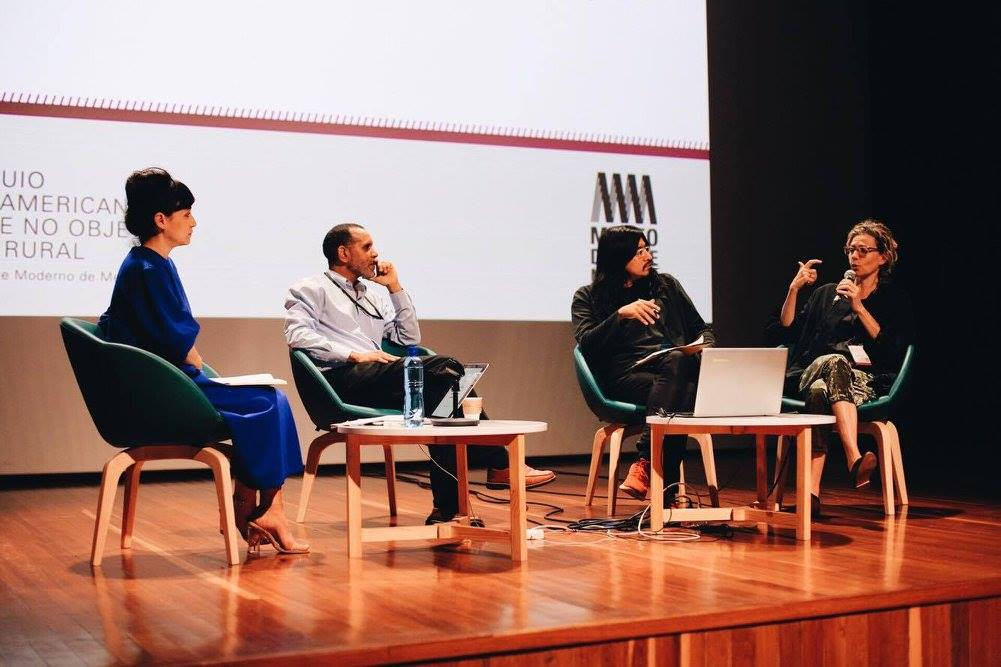
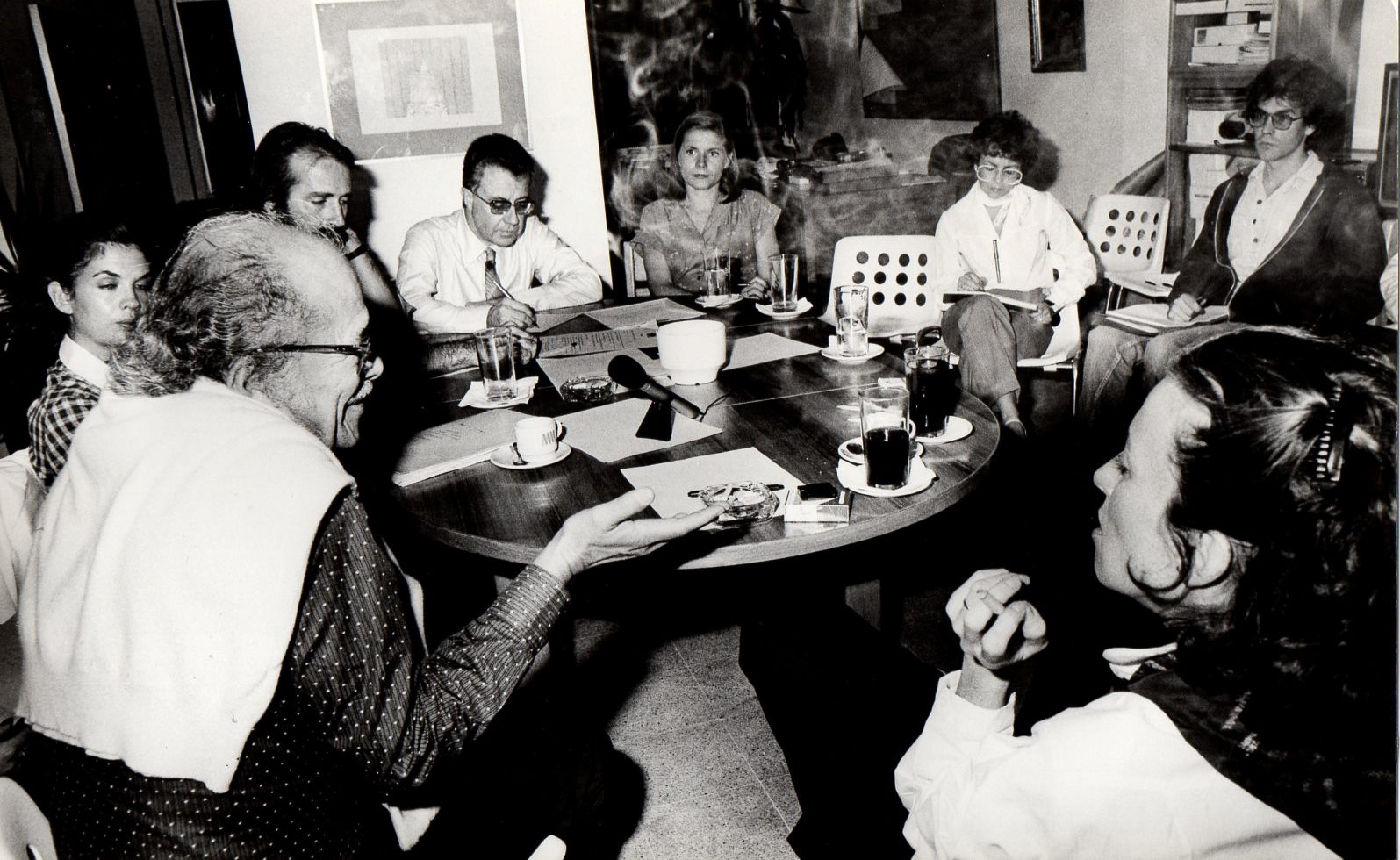
March 10 and 11, 2017
Director: Sofía Hernández Chong Cuy
The Second Latin American Colloquium on Non-Objective Art and Rural Art was an event organized by the Museum of Modern Art of Medellín (MAMM) in March 2017 to bring together curators, critics, and visual artists from Latin America who have advanced the concept of “non-objective art,” transforming it from an aesthetic field into a field of social action.
This Colloquium was conceptualized by Mexican curator Sofía Hernández Chong Cuy, under the coordination of MAMM Chief Curator Emiliano Valdés. This second edition aimed to explore recent artistic spaces and practices outside the city, investigating the role of art in processes of social integration and the cultural revaluation of the natural environment.
The Art of Negotiation, or How to Remember Something That Happened So Long Ago, 1981-2017
II Latin American Colloquium on Non-Objective Art and Rural Art, Medellín, March 10-11, 2017
Essay by Dominique Rodríguez Dalvard
I. The SIERRA Colloquium
Medellín without Alberto Sierra. The “Nicanor Restrepo” of the arts is gone, and with him, an era ends. One of the “Four Evangelists” has died, survived by Miguel González, Eduardo Serrano, and Álvaro Barrios. The only one who came to his wake was González, perhaps the one who has been closest to death. The four divided the country: Sierra in Medellín, Serrano in Bogotá, González in Cali, and Barrios in Barranquilla. They invented a scene, a way of doing things, a temperament shaped by love, hate, coquetry, and a great deal of vanity. They made their “eye” a creed.
Blue Display Case and Prayers
It was blue. That display case, overflowing with books from his childhood, and which would remain overflowing with books for the rest of his days, could only be that color. Or red, or yellow, or orange, any color, except a poorly aged white. That would be his mantra, that everything around him should tell a story, he seemed to repeat. And it wasn’t a matter of accumulating or having, having, having, to mark his territory. No, in fact, he had very little. But little that was significant, considering what mattered to him. Like that Juan Camilo Uribe that hung in the kitchen hallway, covered in the dust of years, which any attempt to clean would have destroyed. It was one of his favorites, and he wanted to see it every day. Like falling asleep looking at Beatriz González’s hunting scene, or chatting with that beautifully naive portrait of María Villa, or the powerful Carlos Correa and an indefatigable Bernardo Salcedo, one of his loves. They were his little things of the soul, those that accompanied him every day, those few that truly did not tire him.
Alberto de Jesús Sierra was called by his mother, the one who dreamed of seeing him become a priest, for the honor of having a priest in the family, and who, God forgive us, tragically died in a plane crash, freed him from that dream. “Oh, what joy! Now I can finally leave the seminary!” he seemed to have cried out providentially with emotion, because how could he miss out on such joyful experiences? How could he deprive himself of the political campaigns through the towns accompanying his friend Patricia Gómez’s father, John Gómez Restrepo, drinking cherry whiskey, laughing, and sleeping in sweltering camps? Or of sailing to the San Bernardo Islands? Or of experiencing Holy Week in Tolú? Or the Miss Rincón del Mar pageant in San Onofre on Easter Sunday? Or of having a whiskey every hour of the day while walking the streets of Madrid? And, as if to continue with the rituals, how could he forgo donning his cassock to officiate one of his interminable
Thursday lunches at his gallery-home, La Oficina—those legendary revels to which only men were welcome, along with the occasional woman whom his attendants deemed fit to join the New Eleven club because “they had prostates.” No, that wouldn’t have been possible if he had stayed with God on that side.
But then he stayed with what he liked about God, on this side: the aesthetic opulence of his churches, the Gregorian chants he studied throughout his Architecture degree, the paintings of saints and languid virgins caressing the chubby Baby Jesus or infant Jesuses and cherubs with golden curls, as well as heavens and hells that he would come to understand very, very well. And he knew how to apply the Christian virtue of piety, which he practiced rigorously while being, oh paradox, perfectly ruthless. His devotion to something or someone, to whom he dedicated all his energy, his eye, his emotion, and his humor upon intuitively discovering that it screamed to him that that something or someone was exceptional, lasted until the moment that something or someone disappointed him. And so, he would withdraw from the scene theatrically, scorning everything, furious and uncompromising. Anger was his strategy for dealing with what he hated.
With Alberto Sierra, there was no middle ground. He blessed many. And he condemned just as many.
Sierra
To think of the Colloquium, as it’s known, is to think of Alberto Sierra. It’s a simple matter of one plus two. While he was the one who organized it, not directed it, and while Juan Acha was the one who conceived it and Sol Beatriz Duque, a friend of his, made it possible, it’s Sierra who we all remember and associate with this milestone in the history of Colombian art. Good for him. Perhaps that’s why the Second Colloquium on Non-Objective and Rural Art, 36 years after the first one in 1981, was dedicated to him. And perhaps that’s also why, when it ended, he died. And with him, an entire moment—a movement—in Medellín’s art scene, the one he himself created. The Colloquium and Sierra, symbiotically linked.
If we consider the significance of the Colloquium, and see it in light of today, it can indeed be called a milestone. Not because what was done there had discovered anything groundbreaking enough to earn it a place in the annals of history with a capital H, but because its intention—and this is the crux of the matter—was to make history. And it did, on its own scale.
For an event that didn’t consciously seek solemnity or reverence, and that set out to speak of the ephemeral, the non-collectible, the rebellion against the market, the introduction of new categories within the
closed universe of artistic genres—giving space to crafts, statistical graphics, Gardel-sized performativity, and even newspaper ads as gestures of art—paradoxically, memory rewarded it. What was intended as an act of sabotage against rigid official historiography ended up becoming a date to which tributes are paid.
And so we see that Sierra, without necessarily being fully aware of it, was sowing seeds in the puritanical province of Medellín. A little wink, we might say, that kind and playful touch that would allow us all to smile at Juan Camilo Uribe’s purgatorial souls, blazing and promising a better place there than here. He infused humor into the solemnity of the Antioquia region. And he gave space to irony. That’s why Bernardo Salcedo’s conceptual still lifes seemed wonderfully ingenious to him, because instead of showing them to us painted, he wrote that “On a table there is a pineapple, two onions. And two vases are visible.” Because even if we’ve seen it like that a thousand times, we hadn’t read it that way. Just as we hadn’t seen that there was a Black Duchamp with a mustache, but deliciously similar to the Frenchman. Álvaro Barrios’s Rose Sélavie couldn’t help but resonate with Sierra’s playful spirit, the one that made him pull a mouse face and rub his little hands together with the mischievousness of someone who knows he’s pulled a prank. Because, never has this saying been more apt, what matters is not being but seeming.
Medellín at that time was a closed-off Medellín. I would like you to look at it thinking, in my opinion, of the best Botero painting we have in our collection. It’s the image of the Cathedral. The largest brick cathedral in the world. We are a people who are always looking at ourselves. And that self-absorption never allowed for international communication. These are Sierra’s own words.
So Medellín had two faces, it seems. One that constructed the heroic and grandiose image of Antioquian industry and workers, when the reality was quite different, and those who operated the machinery of this regional development were peasants, many of them barefoot. Propaganda. Pure propaganda. That mixture of an ambitious yet utterly prudish society could not help but fascinate a man like Sierra, who would do nothing else in life but expose the contradictions of his land. Is that why, I ask, the prison from which Escobar escaped was called La Catedral (The Cathedral)? We are a people full of symbols and rituals. And we Colombians are quite the prayerful bunch. Let’s see how the Sacred Heart is leading us along the fringes of secularism, between apostles and the Pope, on this journey through those colloquies that could well be known as the Sierra Colloquies.
II. Riding through 36 years of history
Echoes of the Colloquium
I read Mirko Lauer, a Peruvian critic who participated in the First Colloquium. In 2007, he reviewed what happened in 1981. And Juan Acha, also Peruvian, but working in Mexico. His text appeared as soon as the Colloquium ended, as a summary published in Sierra’s journal, Re-vista. They problematize the concept of the Colloquium and rebuke anyone who thinks that non-objectualism rejects the object—Acha does so by saying that what it does is rethink it, put it in another place, desacralize it, remove its fetishistic aura, and take it out of the purely commercial circuit. Their stance is imbued with willpower, given that it emerged in the late 1970s, when the Iron Curtain still existed and socialism was still a form of resistance—albeit a highly conceptual one. However, revisiting the idea in 2007, with the Berlin Wall fallen and rampant capitalism as the sole victor, revealed a naiveté and a purpose that the market ultimately overruled. The very thing they sought to break free from its dominance was not achieved. Not even a little.
But, revisiting the ideology more from its essence than its application, what it revealed was a way of confronting the world, the system of values and perspectives constructed since the Renaissance, which enthroned works of art on pedestals and in museums. Non-objectivist artists would then be trying to rediscover the heart, the root of art, that impulse that seeks to evoke a vital experience, that which can embody the ritualistic nature of humankind, that which produces the spirit, the practices that bring people together, their customs, their oral tradition, the stories told and retold through generations. A return to what inspires art. All of this as a clear rejection of an already entrenched system of art production, circulating in galleries and museums, trivializing the experience by turning it into a commodity.
That’s why I like Lauer’s non-heroic character—even though he classifies the non-objectualists as avant-gardists, that is, as disruptors, thinkers of new structures, transformers of social orders—when he reviews the First Colloquium almost thirty years after it took place. He highlights the value of the gesture, of the ideas that were discussed, of that attempt to seek different paths. He acknowledges their limited actions because, in any case, they couldn’t bring about the desired transformations, because it wasn’t possible to break the market, because socialism was better in theory than in practice. I find it interesting to consider this sense of the avant-garde that he gives to this movement that isn’t a movement, nor does it call itself one, but which seeks to move history. So that history, faced with so much novelty, becomes frightened and retreats to the traditional in the face of the threat of movement and freedom. (…) Non-objectualism has suffered the fate of every radical avant-garde. There’s nothing to lament there. Every radical avant-garde arrives, seduces, and then frightens. After the Avant-garde comes a Rappel à l’ordre, a call to order. That’s the story, the theorist wrote. Why do I feel that this phrase fits so well with what we are experiencing in Colombia right now? How can we not sense that we are precisely here, in 2017, at that moment of the call to order, of the reclaiming of certainties, for example, those of “security,” which will define us as a country? Faced with a scenario of change, of making room for the other, of post-conflict as it is now called, we see that the war will be waged by tradition: the church and the politics (of fear) will envelop us in their mantle of continuity and define our political destiny. But perhaps some avant-garde hero will come up with a story that shows us that all we need is a little more inner world, a little more generosity, a little more sense of responsibility for our actions or omissions in our history, a little more role modeling and less reliance on the traditional family, which isn’t exactly the best example around here… anyway. We’ll see what the artists come up with.
Those Years
Something shines through in these two distant yet similar periods: the need to negotiate a space, a time, a place where the ideas that art seeks to express can find a place, and thus, to feel that one is contributing something to the construction of history. Thirty-six years ago, the Museum of Modern Art of Medellín was just being born, with the intention of bringing contemporary art to the inhabitants of this city, without quite knowing what that meant, although with a certainty of what it wanted to avoid, and with the desire to bring a bit of the world, of irreverence, of ideas that were being discussed beyond the mountains. That driving force remains intact, 36 years later. And the need for negotiation remains intact as well.
This will be a constant leap between time, past and present.
In those early 1980s, for its protagonists, Sierra among them, something had to be done in the cultural sphere: the Zea Museum, as the Museum of Antioquia was formerly known, couldn’t be the sole point of reference for what Medellín was. Francisco Antonio Cano, Eladio Vélez, and Pedro Nel Gómez were all very good, of course, but it was necessary to look to the present. Even to focus intently on Débora Arango, something that hadn’t happened before. To look at her was to look at the present, and even the future; that’s why her first retrospective, in 1984, was held in the galleries of the Museum of Modern Art of Medellín. It was necessary to create a place that would somehow show how the city was seeking modernity while coexisting with its past. If we speak in terms of equivalences, the Zea Museum could become to Medellín what the Coltejer Art Biennials were to Medellín—that is, an institutional framework. History passed through there, moving little, as is often the case with history that carries such weight. Meanwhile, the Museum of Modern Art of Medellín and the Colloquium on Non-Objective Art represented the new era. They were unburdened by history and could be approached with fresh perspectives. Both could coexist because more narratives of the city were needed. As the Nigerian writer Chimamanda Adichie would say in *The Danger of a Single Story*:
It is impossible to talk about a single story without talking about power. There is a word from the Igbo language that I recall whenever I think about power structures in the world, and it is “nkali,” a noun whose translation is “to be bigger than the other.” Just like our economic and political worlds, stories are also defined by the principle of nkali. How they are told, who tells them, when they are told, how many stories are actually told, depends on power. A single story creates stereotypes, and the problem with stereotypes is not that they are false, but that they are incomplete. They make a single story the only story.
And that’s what contemporaneity was all about. That’s what it is, in fact. In the capacity to see our demons, those that have so often taken hold, and thus unmask them, or at least, to be aware of their existence and intentions. Also, to see what had gone unseen, because it wasn’t acceptable, because it wasn’t discussed, or simply because no one had paid it any attention and it was time to remedy that. That’s what trying to grow as a society is all about.
In that sense, it was necessary to seek out more voices and perspectives. And those voices were there, ready to be heard. One only had to go, for example, to the Colombo American Center or the Goethe Institut to enjoy the brilliance of Father Luis Alberto Álvarez—again, how religion so profoundly influences this narrative steeped in ritual—a highly cultured film specialist who wrote reviews for the press and brought German Expressionist film series to the people of Medellín starting in the mid-1970s. There was a hunger for everything. Film, exhibitions, and everything else that was labeled art at the 1981 Colloquium itself—such as performances, crafts, folk knowledge, and graphic design—were all present. It was only natural, then, that after a burst of enthusiasm, these cultural enthusiasts, Sierra among them, of course, organized a series of design conferences in Medellín. Italian designer Mario Bellini and French furniture designer Pascal Mourgue, both cutting-edge at the time, came to Medellín. This spurred the creation of a design program at the Pontifical Bolivarian University and the more formal establishment of art schools in the city. Although the Colloquium’s theorists sought to transgress the laws of the market, it prevailed: supply and demand were in full swing.
One thing fueled the other, and without any predetermined purpose or agenda beyond the effervescence and the will of the participants, the city was set in motion. Thus, culture constantly sought relevance and currency. So, when President Belisario Betancur (1982-1986) spoke of housing without down payments, the Museum of Modern Art in Medellín painted that dream home on the floor, to keep it in mind, to recognize its significance, and to discuss it. Similarly, when the metro was planned for the city, the exercise involved tracing the route of the metro line and placing the houses of museum visitors along it. This was to show them how this transportation system would transform the city’s destiny (the first line took 10 years to build, with construction beginning in 1985). The Museum also partnered with the administration of Mayor Juan Felipe Gaviria (1983-1984) to offer urban tours of Medellín, visiting bridges as symbols of its urban development. It was natural that these urban concerns would give rise to the connection between art and the city (and this connection endures; one only needs to see how today the descent towards Medellín, in addition to posters of girls in jeans, features murals of the region sponsored by private companies). Thanks to this, the Cerro Nutibara Sculpture Park, the first of its kind in the country, was created in 1983, featuring ten representatives of national and Latin American art, such as Carlos Rojas, Ronny Vayda, Julio Le Parc, and Carlos Cruz-Diez, among others. Later, a sculpture competition was held—sculpture was an important, powerful, and prominent icon of public art—to adorn the newly built José María Córdova Airport (1985) in Rionegro, another symbol of the city’s progress. This competition included works by Hugo Zapata, Bernardo Salcedo, Édgar Negret, and Clemencia Echeverri. A few years later, the Riogrande II competition took place, where artists envisioned the city on a grand scale and considered how their work could enrich it. Is it worth remembering that Sierra was behind much of this push?
That urban planning tradition has been present in Medellín since the early 1960s; it wasn’t a sudden whim at the beginning of the century, born from the genius of some mayor. The idea was to approach urban planning with aesthetic considerations, as had been done for decades in Medellín, as evidenced by its buildings, especially in the city center.
But then the violence hit.
And that reshaped everything. That voracious and creative spirit brought the city to a standstill and forced it to try to understand what was happening. Living in Medellín became a struggle for survival. The 1990s practically wiped everything out; it was unprecedented because of the sheer volume of events and the damage inflicted. As always, some, like Sierra, tried to keep life going, but for most, the common thread was: what beauty can we possibly envision when all we’re doing is running from death? And even if death didn’t occur, violence permeated daily life with its aura, leaving its devastation in its wake. The spirit of easy money from drug trafficking began to seep through the cracks of society. The “turnkey” model—that strategy of putting up money for the builder and expecting them to make it grow and deliver a finished building without regard for regulations or neighbors to maintain a good relationship with—damaged Medellín considerably. It showed that it was possible to build without technique or beauty, much less considering the surroundings. And the dirty money reached the art world as well. There were those who sold art to the drug lords, in Medellín and Bogotá, and wherever else they wanted. Many succumbed to the temptation of easy money, but in the end, the capital is a big city, and some even managed to blend in (right?), but in Medellín, a small town in a big hell, where the cartel boss keeps tabs on everyone, and what if you didn’t want to sell to the boss? How did Sierra manage to avoid such a huge risk? It seems he played it well, as audacious as ever, because he continued talking about the most unusual things, the kind that don’t interest drug traffickers: happenings, performances, and video installations. Furthermore, he secured his position with universities and institutions by curating exhibitions and building collections, thus avoiding dependence on his gallery’s sales. And to avoid any pressure from businessmen, including the bigwigs, he protected himself by cultivating their taste with the icons of modernism, thereby entering that sphere which was definitively the escape route from falling into the clutches of the newly enriched underworld. A parallel to non-objective art and its negotiation strategies, flirting with theoretical esotericism at times, but always grounded in the reality of the market.
Seduction and Identity
We were talking about negotiation. Everything that art and culture achieved in Medellín was through negotiation. Through shrewdness, through local pride. That salesman’s spirit had to seep into Sierra somehow, from his shopkeeper father. Not because he was the most commercially minded gallery owner in the world, because he never was, but because he thought beyond the cash register. And he had the opportunity to influence public policy in his city… what other gallery owner has done that in Colombia? And that, perhaps, was his greatest contribution to art: the impact on the responsibility of private enterprise toward culture. He left that legacy. It’s true. There are no better patrons of the arts in Colombia than the people of Medellín. We see that Sierra left his legacy while he was still alive.
And therein lies a point of connection with the proposals presented at this year’s Colloquium. We will see this through several of the exhibited works: Negotiation as a formula of art, more than any other consideration; the legacy of non-objectualism; the word as a method of persuasion, as persuasive articulation, as the director of the Second Colloquium, the Mexican Sofía Hernández Chong-Cui, put it.
The negotiation by the American artist Jill Magid with the family of the architect Luis Barragán, a national treasure, whom she convinced—after an intense exercise of marvelous and perversely orchestrated seduction, recorded in photographs and video—to allow her to open his mausoleum, extract his ashes, and take the necessary amount to commission a ring. With this ring, she would propose to the owner of the architect’s archive, the Italian Federica Zanco, that she return the material to his native Mexico. The missing piece in the urn would be replaced with 525 grams of one of the silver horses, another of Barragán’s personal obsessions. Everything was coldly calculated. And impeccably executed. Magid did so by capturing Barragán’s own gestures, studying them down to the last detail, thus establishing a connection with his heir, the obsessive Federica Zanco, who at one point told her husband, Rolf Fehlbaum, the owner of the design products factory Vitra, that instead of an engagement ring, he should give her the architect’s archive. The work, The Proposal, clearly did not go unnoticed in Mexico.
“Everything is merchandise for the discourse of conceptual art, so lacking in art, so poor in concept, so abundant in rhetoric,” wrote Jesús Silva-Herzog, a Mexican lawyer, political scientist, and columnist, indignantly. Writers Juan Villoro and Helena Poniatowska echoed this sentiment. This opened up the real discussion that Mexican curator Magali Arriola sought to highlight by bringing this artistic case to the table: what role can artistic processes play in outlining a field of political action and social integration without activist or pamphleteering slant, and in the elaboration of narratives, even if partially fictitious, for the development of critical thinking.
By presenting this work to us, Arriola is asking us what heritage means, to whom it belongs, and to what extent vanity extends to those who seek to be included in history. In fact, she questions who writes this history, for what purposes, and who is recorded or forgotten. She further complicates the case with another work, also from Mexico: a piece by Teresa Margolles. The artist offered the mother of a boy murdered by a gang the option of paying for his burial, as she had no other means, in exchange for his pierced tongue, to be displayed in a glass case at the Palace of Fine Arts—where figures ranging from Cantinflas to Gabriel García Márquez have lain in state. Her objective: to prevent (macabrely) his being forgotten.
Neither of the two artists would have conceived of these works to be sold, nor as an exchange, at least not until now, Arriola explains. They do not participate in the speculative market of contemporary art and reveal the different types of economics that drive the art world. Both artists resort to a barter economy. Why do they do this? What are these artists trying to point out? With what authority? These works propose a discussion about how ethical boundaries are crossed to make a point, to offer a critique. They explore how art can engage with death and memory with great sophistication, yes, but without any shame. How far does art’s provocation go? How is it justified? The provocative aspect also becomes relevant when we see how this fight ignites once someone else, either because they are a foreigner or because they have penetrated the highest symbol of the nation, enters the scene. The debate about how an American woman can interfere with national heritage, the Barragán archive, or how a Mexican woman can place the tongue of an anonymous dead person in the Palace of Fine Arts, arises precisely because they have engaged with symbols. Who had complained about the archive when it was sold? Who had noticed the death of this young man, one among thousands, if not because a part of themselves rested in that space sacred to Mexican identity? (These works) denounce a widespread violence that exposes the fact that some lives are valued more than others, the curator concludes, leaving the debate open for discussion. We might also ask ourselves why Adolpho Leirner sold the greatest treasures of modern Brazilian art to the Museum of Fine Arts, Houston, given its similar nationalist undertones. Or did anyone here fight for Fernell?
But the fruits of their labor are indeed being reaped… that’s what so many worked for… Maricarmen Ramírez presented her monumental Inverted Utopias: Avant-Garde Art in Latin America, right there in Houston in 2004, and the Latin American art scene salivated. It finally felt seen. But who defined Latin America? For what buyer? From what perspective and with what criteria? How to unify a shared vision or common concerns? Who is interested in creating a notion of Latin America? How have institutions (with their L.A. branches or specialized curatorial departments for the continent) and projects like Daros, which construct and monetize a particular perspective, built upon these ideas? Not even Juan Acha’s authority could have stopped this momentum.
He shunned the market, the notion of art as an object to be sold. And look at us today. Pure objects and ideas for sale, as always, despite the resistance from conceptual artists, because, as the Cuban curator Félix Suazo, who lives in Caracas, ironically put it, today non-objective things are sold for more than objects and things themselves. Projects, ideas, gestures, rights are for sale.
Nevertheless, questions about the national, about nationalism, about identity and what defines us as a continent, as countries, remain ethereal, even though they are fundamental to knowing who we are, what unites us, and what divides us. While a couple of years ago it seemed that Latin America was a bloc, we were defined as the continent of the future, because of economic growth, because of the divine treasure of youth that surrounded us, today, in light of the financial crisis and the fall in oil prices, or because of the clear political division of the ALBA countries that stand with Venezuela and all the rest that defend the spirit of democracy, it is revealed that we were not as united as they tried to portray us. Meanwhile, Fidel Castro died, Daniel Ortega was re-elected, and Venezuelan rhetoric radicalized to the point of justifying its slide into dictatorship. Things aren’t any better here in Colombia, a polarized and angry country that struggles to define what makes it Colombian beyond the national team’s flag. The people are tired of the war, but they don’t want to leave it. It’s no longer the gunfire that affects them, but the horrific consequences of having anesthetized the entire country to the point that it no longer sees or feels anything. It doesn’t want to see anything, much less feel anything. We could be united by pain, as Doris Salcedo has said so many times, the only front that transcends social class and accent. And we could indeed see ourselves reflected there, in the fact that we have all lost a family member, a friend, our trust. But not even that.
What a normalization.
Violence has become invisible, even though we know it’s there, lurking, stalking.
Violence became normalized, leading us to believe that everything was back to normal. When, no. Not necessarily. And then the contradiction appears, though never so much like a reality show we’re immersed in without even realizing it: I’ve never seen so many foreigners in Medellín as now, tourists in Comuna 13, on graffiti tours, visiting Escobar’s neighborhood, the metro, the Metrocable, the hillsides of 8th Street, drinking beer in Parque Lleras, filling the bars and restaurants, in that apparent calm, which is nothing but a false calm because the dead keep appearing, only now not in the streets shot dead, but dismembered in car trunks. And lest we forget that violence is lurking around every corner, Víctor Gaviria presents *The Woman of the Animal*, which may be the story of a woman whose life was made miserable and terrifying by her husband, but she is not an extraordinary woman. On the contrary, she is the fruit of your womb, Jesus, one of so many subjected to the prevailing gender violence, a product of rampant machismo. It seems easier, instead of talking about femicide, to label them as crazy and, in this current climate of public safety, lump them in with the victims of street gangland score-settling, as if that would more easily justify their deaths.
And then, another presentation from the Colloquium comes to mind, further demonstrating that artistic themes can be connected, if one is willing to see them, to the reality that surrounds us. The Peruvian researcher and curator of TEOR/ética, Miguel López, presented the case of the decades-long invisibility of the Peruvian artist Teresa Burga within the art scene. She is a good example of how certain artistic aesthetics exceeded the bounds of intelligibility at specific moments. Those works that openly questioned how to achieve autonomy in a society codified to ensure subjugation—with scenography she called Ambientaciones in 1967, which showed, for example, a drawing of a woman attached to a bed, as if displaying her place of “come and dispose of me”—dependence, or inequality, had to wait 45 years to see the light again and engage in dialogue with her peers.
López recounts that at 80 years old, she was presented and celebrated at the Venice Biennale, but no one questions what structures have perpetuated that exclusion. We must be able to revisit those narratives and dismantle them.
What are the legacies of non-objective art? López wondered, its inheritances, its extensions, its discontinuities? And she raised the possibility of a “non-legacy or an oblique legacy,” which could be explained by the fact that non-objective artists hunted the tiger and were frightened by its skin; they gave it free rein and invited artists to break the mold, as Teresa Burga did with her critiques of sexist and patriarchal society, and they failed to recognize its relevance and contemporaneity, so, without properly valuing it, they excluded it from history. Of course, this is related to the fact that those who narrate history, and the history of art as well, are usually men. Although Teresa Burga’s work in the late 1960s was addressing the most heated debates of that moment in history—the feminist movement—no one took notice. For the Colloquium, her work was merely an instrument (“An excellent example of conceptualist expression,” Acha called it) to showcase alternative ways of presenting artistic discourse—she employed graphs and statistics and collaborated with the social sciences in her data collection, creating a documentary project—but the content of what she had to say was not explored in depth; instead, the focus was limited to praising the form. Nothing more. This lack of legitimacy from the art world erased her from history until almost four decades later when her work was rediscovered and properly appreciated. In reality, this was the true embodiment of what Acha sought: dislodging the object of art from its traditional structures and giving it an infinitely broader scope. But they didn’t see it. What should have been done, López continues, was to redefine the ways of understanding citizenship, the economy, public space, legal discourses, language, educational and public health policies, access to representation, and democratic frameworks. But no one documented what she was doing. The works were never even described in art history catalogs, and once again, the question remains: who writes history? This highlights the precariousness and fragility of art history, the curator concludes.
With an aggravating factor, as Griselda Pollock points out: “The absence of critical recognition at the right moment means there is no possibility of recovering that opportunity to be seen in one’s own history, just as the absence of historical records or archives can never be retrospectively filled by what was never said.”
Thus, Acha’s aspirations to make the term a currency for Latin American critical exchange, at least with respect to certain ideas such as feminism, didn’t get very far. Returning to the references to Víctor Gaviria’s brutal violence, Miguel López’s words are relevant as an explanation for the prevalence of machismo as a social ill: Women have been made invisible, erased, pathologized, represented as a servile subjectivity without agency.
And that is a violent type of violence.
As is also the violence that attempts to explain itself without evidence. Like the cases presented by Félix Suazo. The curator presents the works of four Venezuelan artists—Teresa Mulet, Érika Ordosgoitti, Iván Candeo, and Juan Toro—who seek to highlight the systematic violation of human rights in that country, a reality that citizens feel, experience, and perceive, but whose facts are difficult to document given the dangerous control of information that exists there. Thus, Suazo asks what art about violence can do amidst violence and revisits the question that Juan Acha himself posed in 1981: To what extent can a system of signs communicate a reality to us?
Each artist is more incisive than the last. Mulet, as if constructing a graph, adds silhouettes representing each death recorded in the few public statistics, reaching 24,763 repeated figures. She does the same with tall stacks of paper, each sheet representing a death. Her exercise with numbers, anonymous beings who are little more than figures she seeks to individualize, relies on sheer volume to move and capture the attention of a country blinded by its authorities.
For her part, Ordosgoitti composes powerful oral narratives in video format that vomit forth what she is feeling, and she also transgresses order and control, undressing before the statues of the heroes that the establishment claims to revere.
Iván Candeo takes the famous red and black flag with a square in the center, from the 1813 War to the Death decree issued by Simón Bolívar, and reinterprets it in 2010, almost as if alluding to the fact that his country suffers such violence today because of it. And in another work, he produces repetitive images of a boxing tournament, on the one hand, and a moving hearse, on the other, to exhaust the viewer through sheer repetition, of punches and blows that lead nowhere, and of that endless movement toward the cemetery that never ends. For him, this path to nothingness is the tragic pattern of his country’s recent history.
And finally, Juan Toro confronts those who doubt whether there are violent deaths in Venezuela, and without offering an opinion, he does so by photographing 80 meters of death tags, the kind that hang from toes in morgues. He also takes enormous photographs, one-meter enlargements of the tiny, destructive lead pellets extracted from a body, and displays them on that advertising scale almost as a morbid game, where he ironically questions how, as a society, we have chosen to worship death.
Archives are closed or opened, but what happens when artists work without archives, without records, without news? the curator asks. They work with the little visible archive that exists, they are building it, and they are using archival formulas, such as classification and order, to explain something inexplicable. It is about building archives in a country where a veiled history is being constructed, like Venezuela.
And then I think about the live history we are witnessing. Here and now. We are no longer talking about the construction of 19th-century Russian history, to take a specific example, as seen by the Tsarist regime on one hand, by the revolutionaries on the other, and by the artists, writers, or composers, finally; nor are we in times of an idealized construction of Mao’s communist China. No, it is history unfolding before our eyes, and how are we going to tell it, and through what pen, lens, or political discourse?
Thus, Suazo concludes that art can indeed communicate a reality as long as it maintains its position of immediate otherness. That is, on the condition of, or thanks to, its capacity to be other; art is not violence per se, but rather it can sense and represent it. When its dissimilarity is as powerful as its supposed referent. “The images of art are operations that produce a distancing, a dissimilarity,” the curator concludes, quoting Rancière.
The Intention
The Gesture. The intention. Perhaps that’s what resonates most with me when trying to understand this concept of non-objective art. Even the desire for resistance, both then and now. Yesterday, a rebellion still dreamt of by anti-capitalist discourse during the Cold War, before the Berlin Wall had fallen, burying the socialist dream. These artists wanted to break free from the market system so successfully constructed by gallery owners, biennials, critics, media, and collectors. They thought they could dismantle this productive system by declaring war on it, refusing to participate in its events, criticizing it in new arenas, pointing out its trivialization, its stifling of creativity, its lack of ambition to think of new things in new formats.
But today, years later, we would realize that it was impossible to escape the market and that it had the brilliance to include “gestures” in its portfolio and turn them into collectibles, just as it took on the task of selling records of performances, souvenirs, and history.
And yet. Artists insist on rebelling. It’s their nature. That’s why, as Sofía Hernández Chong-Cui, director of the Second Colloquium, suggests, perhaps what we should do today is think about non-collectible art, about updating the term to reflect on our history in the face of market domination.
To go through the processes, through persuasion and negotiation, and through the reinterpretation of the environment. While—as Hernández Ch-C reminds us—Marta Minujín, in 1981, was masterfully managing and mobilizing to generate an experience (like burning a giant Gardel effigy to provoke a whole range of reactions, which she did), today’s artists seek to unleash processes through exchanges. On a different, more intimate scale, it seems. The intention is for the artist to experience life with another group of people, different from their own (from mine and ours), to exchange knowledge, to learn from them, which is profoundly anthropological. Thus, if before (although it still happens…) Indigenous people, Black people, “oddballs,” or the sick were photographed and exhibited and hung in galleries, perhaps without their knowledge, then perhaps this moment in art, where we are not the guests—I mean the public—could be more ethical, because we wouldn’t intrude where we don’t belong. More boring, too, because, as Hernández Ch-C recounted, the most intense moments are unfolding without our knowledge. Those processes will remain hidden. Despite this understanding, we still demand to be shown “something,” so we are subject to the narrative effectiveness of the artist’s interpretation of this experience. For those of us who were not part of the process, its understanding is still incomplete, resulting in a superficial visit in which we are far from grasping the implications of the relationship the artist forges with a community.
These are, therefore, new (well, they’ve been around for years) forms of production that differ from mounting an exhibition and that reveal questions about how to attract new audiences to museums (if Muhammad won’t come to the mountain…), as well as rethinking the function of art beyond the small art world.
We see this today in something very concrete from the 2017 Colloquium: the commitment to “rural art.” In 1981, urban growth forced reflection on the city, which led the Colloquium to revolve not only around the axis of non-objectualism but also around that of “urban art.” Its contemporary variant is to consider the boundary between the city and the countryside, with all that this new-old debate reveals. Cities swallowing up the countryside, often by force, shrinking the agricultural frontier more and more each day, devouring its people as well. Forcibly changing their way of life.
Of course, these are real problems with real people, so many of these artist-community discussions come down to negotiation. It’s about making it part of the art game and part of the creative process. And yes, this negotiation does complicate the work… sometimes it even overwhelms it.
The experience of talking and dyeing the fique with several of the women from Comuna 8 was probably much more enriching for Susana Mejía than it was for us, visitors with the limited time of tourists who get swept away by the current, like shrimp, if they don’t make the effort to stay with the rest of the group. What we missed were those women telling their stories during the coloring exercise, recounting how they came to live on those steep hillsides, how they ended up planting those fique plants to prevent further erosion, and then learning to use its fibers to earn a living. That’s what we didn’t hear or know. We, the tourists, the public, took pretty pictures for Instagram with the colorful fique threads hanging on a little bridge.
The same thing could have happened to Fernando García-Dory with his Campo Adentro project, which was unfortunately disrupted by rain that prevented the tourist public from hearing the many stories the residents of El Faro had to say, such as Blanca, a gardener from that part of Comuna 8. But he, being cautious, left behind a document for someone, like me and possibly others, to read someday. There, we clearly see other forms of art: activism. Bringing to the art scene themes that need more voices, in every sphere possible.
(As curator Ana Laura López de la Torre and artist Carolina Caycedo also do at this Colloquium. López de la Torre must reach a series of agreements with the neighbors of the cultural center she directs in Montevideo so that the place can regain its relevance. Her negotiations are small-scale but have a big impact: using the neighborhood garden and creatively resolving real issues with limited resources, such as furnishing the center’s theater with chairs so people have a place to talk and meet—something that has been lost and is the real problem to be solved. Caycedo, in her alliance with the organization Ríos Vivos, is staging a performance denouncing mining and its impact on the entire community. The aim is to bring highly problematic and current issues to the art scene to open up the debate.)
She, Doña Blanca, never one to mince words, basically asks the most intelligent question anyone could ask: What’s the point of a garden if there’s no house? He’s referring, of course, to the place they took us for a picnic, the Circunvalar Garden, a landscaping project—and, we’ll see, a control project—on the hillside of Comuna 8, an informal settlement that used to be more violent than it is now, but which experiences violence in different ways. To stop construction, it wasn’t necessary to create the Circunvalar Garden, because if there wasn’t going to be any authority to enforce the regulations anyway, it was pointless to have poured a mass of cement in vain. (…) Now I think it wasn’t necessary to do it to say, “This is where the city ends,” and that no more housing would be built above it, when the regulations weren’t being followed anyway. They could have improved the housing and paid the territorial control people to enforce the regulations from there. Because we all know that if people in need moved there, it wouldn’t bother us. What bothers us is that those with the most money want to get ahead at the expense of the poor. It’s always those with the most power crushing the poor.
As she rightly says, we know that if people in need were to arrive there, it wouldn’t bother anyone (to occupy those lands). This forces us to question these spaces in cities and for whom urban planning is intended. These urban reclamations or “regenerations” win so many awards, but they take little account of the people they directly affect. Because who lives in these territories? Those who have nothing, displaced by violence, rural or urban, people without any purchasing power who, years ago, risked their lives on a mountainside and tried to build a new life there from scratch, fully aware of its illegality, but with few other options. Their temporary situation ceased to be temporary a long time ago, and, lacking other opportunities, this is their home.
The community asks itself – this is an excerpt from El Faro, Comuna 8, Community Diagnosis and Proposals for the Comprehensive Improvement of the Neighborhood – what good is a park if those of us who have lived here for so long are evicted and therefore cannot enjoy it? (…) the most important thing for any type of intervention in Golondrinas and El Faro should be the development of risk mitigation works, since with this we can guarantee a safe place to live.
The discussion about rural life becomes relevant insofar as it truly is a geographical boundary of the city. That countryside, those mountains, are the last memory for the farmer of what his life once was. When you come from the countryside to the city, the city is the last thing you want to see. You get lost in all the streets, and yet these hillsides are what connect you to what you were like in the countryside, explains Blanca, the gardener.
The diagnostic report reiterates this point: The community’s proposal is to implement a food security project in this area, focusing on productive gardens. This would allow us to defend and guarantee the right to food and the ability to remain in the territory. (…) We need to be able to subsist on our own through these gardens; we need to be able to sell the produce by establishing a marketing company.
And there, a key point is highlighted, one that artist María Buenaventura delves into in her research: food. The right to food. Along with Judith, Blanca, Aracelly, Maritza, Milbia, and Mayory—all mountain dwellers, cooks, gardeners, and resilient women—María invited the guests to visit the Garden and, in turn, meet those who live there. She arranged a picnic and crispy organic tacos as an excuse to sit down and talk. I don’t know how much of the conversation she hoped for actually unfolded, but, once again, she laid the issues, quite literally, on the tablecloth (red and white checkered, as it should be). And she left us with her manifesto. Sitting on the ground, we not only give thanks for the hard work of farmers, transporters, helpers, and cooks, but also for the 10,000 years of agricultural history on this continent, the microbes that fixed minerals in the plants, the sun that warmed the mud, the comets that crashed into Earth—nothing is truly ours. Every little piece of plant we eat today was planted in living soil, the result of 300 generations of people who today provide the 36,000 varieties of beans we know, the 500 varieties of corn in Colombia, the 30 varieties of lettuce grown in gardens, the mangoes, the plantains, the lemons, the flowers, the air in the trees, the life that surrounds us and flows in and out of us. Everything is ours.
We eat earth, sun, and water. Stardust. No wonder looking at them fills us with nostalgia, the artist concludes, trying to make us fall in love with the earth as much as she does with it.
And to continue with the kindness and good intentions, there was another negotiation proposal at the Colloquium, this one very urban.
How strange, I saw you pass by yesterday and when I wanted to call you, you’d be surprised. Despite how much I loved you, can you believe it… I forgot your name…
Dedication from apartment 1904 of the Ciudad del Río residential complex—right next to the Museum of Modern Art of Medellín—to its neighbor in 1902, the one he runs into in the elevator every day. With this “Neighbor Serenade,” by Harold Ortiz, the abstract concept of “non-objective art” was cleverly put into practice. And it demonstrated that the stages of art are not in exhibition halls, but in residential buildings, serving as a means to bring together people who see each other every day, but without really seeing each other. An exercise among neighbors, those of the building and with the Museum itself, to foster relationships, to see that common bonds can be forged through culture.
The truths of sarcasm
What does post-truth, so fashionable this semester, have to do with the Colloquium? With the ideas outlined in the Second Colloquium?
“It seems to me a new word to describe the oldest thing in the world: the lie,” Argentine journalist Martín Caparrós recently replied to a question on the subject from the supplement La Gaceta, of El País in Cali. Thus, in our times, it seems that a lie repeated over and over can become the truth. Or a half-truth. Or one constructed to appear true. Convenient, calculated. Art?
If something doesn’t exist, do we invent it? Do we give it form to prove a point? Yes. Perhaps some truth slips through that way. Then comes the delirium of the artist Lucas Ospina with his invented—or “found” (objet trouvé?), because it was lost—presentation of what Eduardo Serrano supposedly said in 1981. The only presentation not included in the proceedings of the First Colloquium, even though the curator is alive and well. Ospina would thus reveal the truth of the imposter (who is it?), of the fourth, or first, or second, or third Apostle, as he, Sierra, Miguel González, and Álvaro Barrios were once known. If we’re talking about post-truth, this rigorous work would fit the bill. And the tone, irreverent, crudely brilliant, sums up the spirit of what this Colloquium was all about: words to play with and mock everything, to justify everything, to create everything. To say everything. An invented curatorship by the curator who invented himself (or perhaps the artist?). The non-objective, the non-object (though brimming with documents, connections, stories, and testimonies) as an excuse to “sell” an idea. We could almost repeat some of Miguel López’s words to endorse Ospina’s discourse: His gestures (his own, but also Serrano’s) remind us that the history bequeathed to us, History itself, is nothing more than a mere theater of appearances.
And we then see the intelligence of humor, its speed, the sharpness of sarcasm as a vehicle for thought. As when Ospina presents us with two versions of Eduardo Serrano’s own account of a performance by the Cuban artist Tania Bruguera (2009) in which, during a panel discussion between two demobilized individuals (from the paramilitaries and the guerrilla) and a victim, trays of cocaine began circulating among the audience, sparking a tremendous national controversy:
The two Serranos:
– First, in 2009: The bad thing, perhaps, was the censorship of Tania Bruguera’s exhibition at the National Museum (it was at the National University). The somewhat provincial relationship of the media and the public with that exhibition, because she wasn’t promoting cocaine use; what she was doing was putting her finger on the wound of an evil that greatly affects us Colombians.
– Later on national TV…: No, definitely, art doesn’t justify everything. Art has traditionally had three fundamental ingredients: an aesthetic component, an ethical one, and a social function. The aesthetic has taken a backseat in contemporary art, but neither the aesthetic component nor the social function has. Many contemporary artists resort to bizarre actions to attract media and public attention, and I believe they succeed. The actions of the artist (Tania Bruguera), like those that occurred yesterday at the National University, wouldn’t have made the news if she hadn’t violated an ethical precept: contemporary art is provocative; it provokes reflection, reactions, and actions, but not everything provocative is art.
Hmm. Yes, it’s the same person speaking. And so, the artist Ospina weaves a 21st-century narrative—because he says that after so many years since the new millennium began, it hadn’t truly started until Donald Trump took office as President of the United States in January of this year, inaugurating a new era—where two versions of the same person coexist. And more than that. Where contradiction is the very condition of the present. The distance between theory and practice. Autofiction, biographical narratives with hints of imagination and invention. Mere post-truth.
(This little word helps us understand specific gestures: that Luis Barragán, the Mexican architect we discussed a few pages back, incredibly famous and incredibly wealthy, had the extravagance of collecting posters, assigning them the Pantone color of the original, in case they faded, so he could reproduce them. How can we not think of Trump himself, who has copies of great works of art in his marble house, creating his own personal museum? Instead of owning originals, it’s better to play it safe and have, for example, a David at home, or a Trevi Fountain, or a Saint Teresa in Ecstasy, to keep them there, by the fireplace. It reveals the mentality that everything can be COPIED AND BOUGHT.)
The art object—I return to Ospina after the digression of memory—also becomes a falsehood, a fake art object. We can see this in the case of the Alzate family (the fake pre-Columbian sculptures by Alzate, filled with drugs, which were part of the Indigenous Malice exhibition) and the Figueroa family (the fake artist Pedro Manrique Figueroa claiming that his “narrative will triumph”). We can see a relationship between urban and rural art, also between the countryside and the city, in what we call coca and later cocaine, or also between centers: the center of the country, Bogotá, and the provinces, or the centers of the world—the First World, the Third World, and even the Fourth World—and all this relationship between object-based and non-object-based art.
What is true? What is false? Everything is, and nothing is. And so it goes. It’s true that there’s a photo of a bunch of children staring at their phones with Rembrandt’s “The Night Watch” in the background, evidencing a lost generation. It may also be true what the Rijksmuseum in Amsterdam says, that the children in the photo were actually looking at the museum’s app at the moment the picture was taken, taking their virtual tour… Who’s telling the truth? Who’s lying? Does the original even matter? “Power is the ability to define what is real,” Ospina quotes Robert Kramer, reiterating that this is the truth of our times, the truth that sells best, the one that’s best displayed (and navigated), regardless of whether it’s real or virtual. That’s the real power.
And although they know this, he, like the good artist he is, tries to unmask it, to expose power. As does the Brazilian artist Ricardo Basbaum, who invents an object that, paradoxically, must disappear, dematerialize, so that things can continue. But before this happens, it must conquer the world, colonize it, permeate it, infect it, go viral. Only then, when it’s inside everyone, can the switch be flipped off. This object that must disappear is a bathtub-shaped structure (I suppose) with a hole in the center, large enough to be noticeable and unsettling, making us take it into account, with a touch of sympathy. Almost like a game.
Basbaum, under the premise of “Would you like to participate in an artistic experience?”, had countless people, for years and years, interact with his “bathtub,” use it, play with it, inside it, hang it, walk it around like a dog (it even made it to Documenta in Kassel). Why? A virus makes you uncomfortable, awakens you, opens your eyes, and makes you feel that things aren’t right. And, you can even defeat it. It’s a fitting metaphor for societies submerged in the enforced silence of dictatorship—he coined this concept right in the 80s, years that were just witnessing the end of his country’s regime—and that need to reinvent themselves, to reclaim the public sphere. To be infused with ideas that were stifled by repression. To make us believe again.
Nothing could be more relevant.
Nothing.
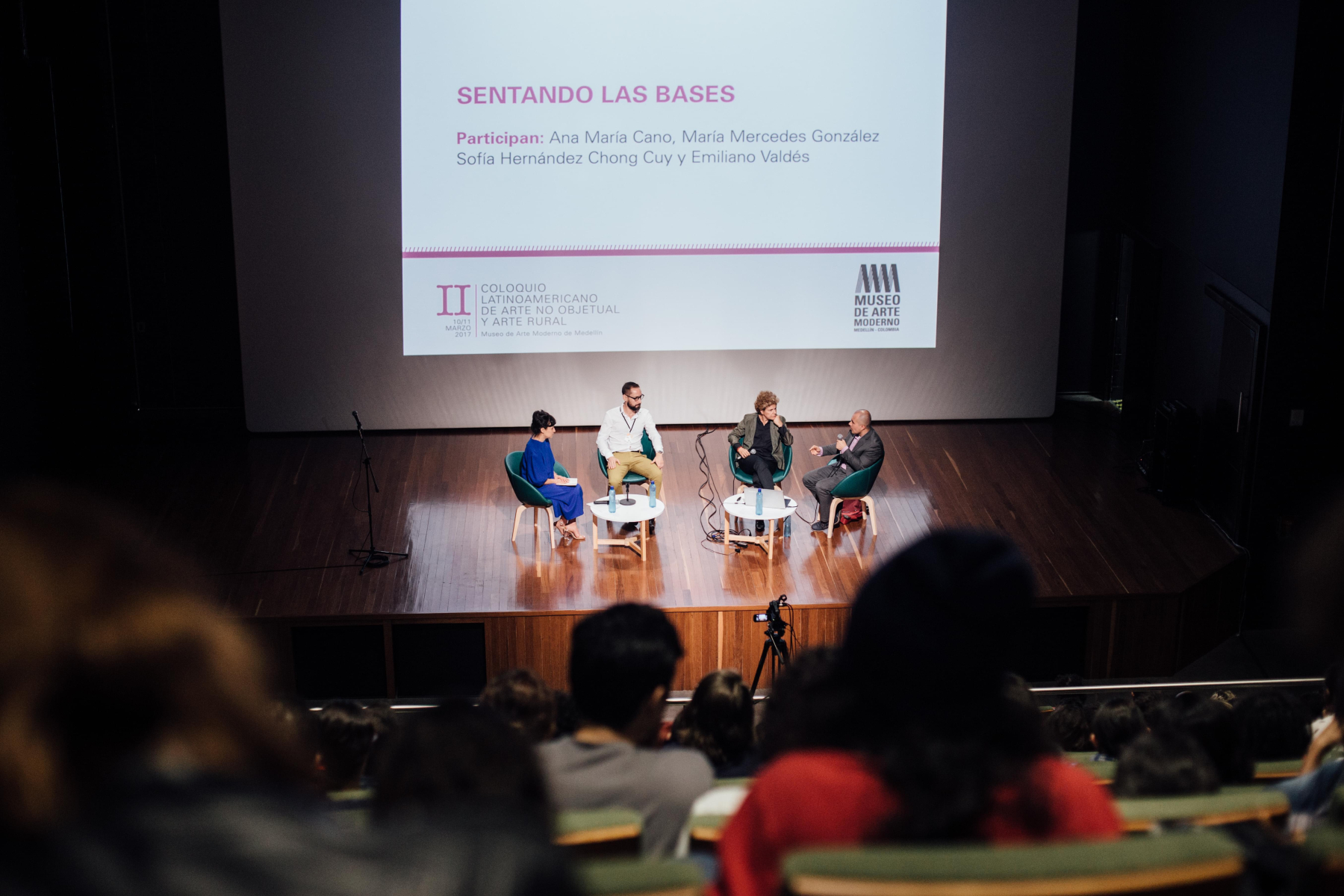
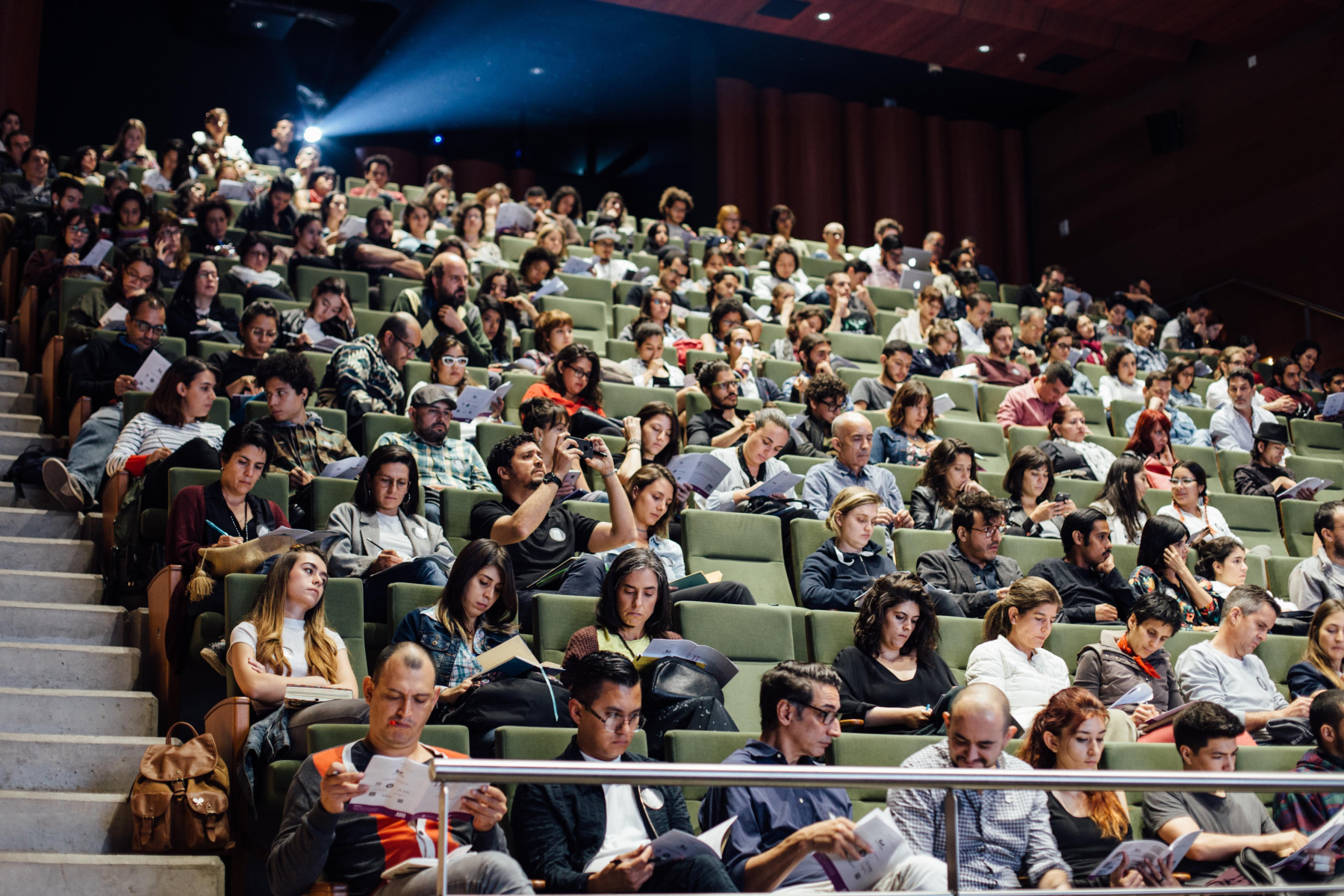
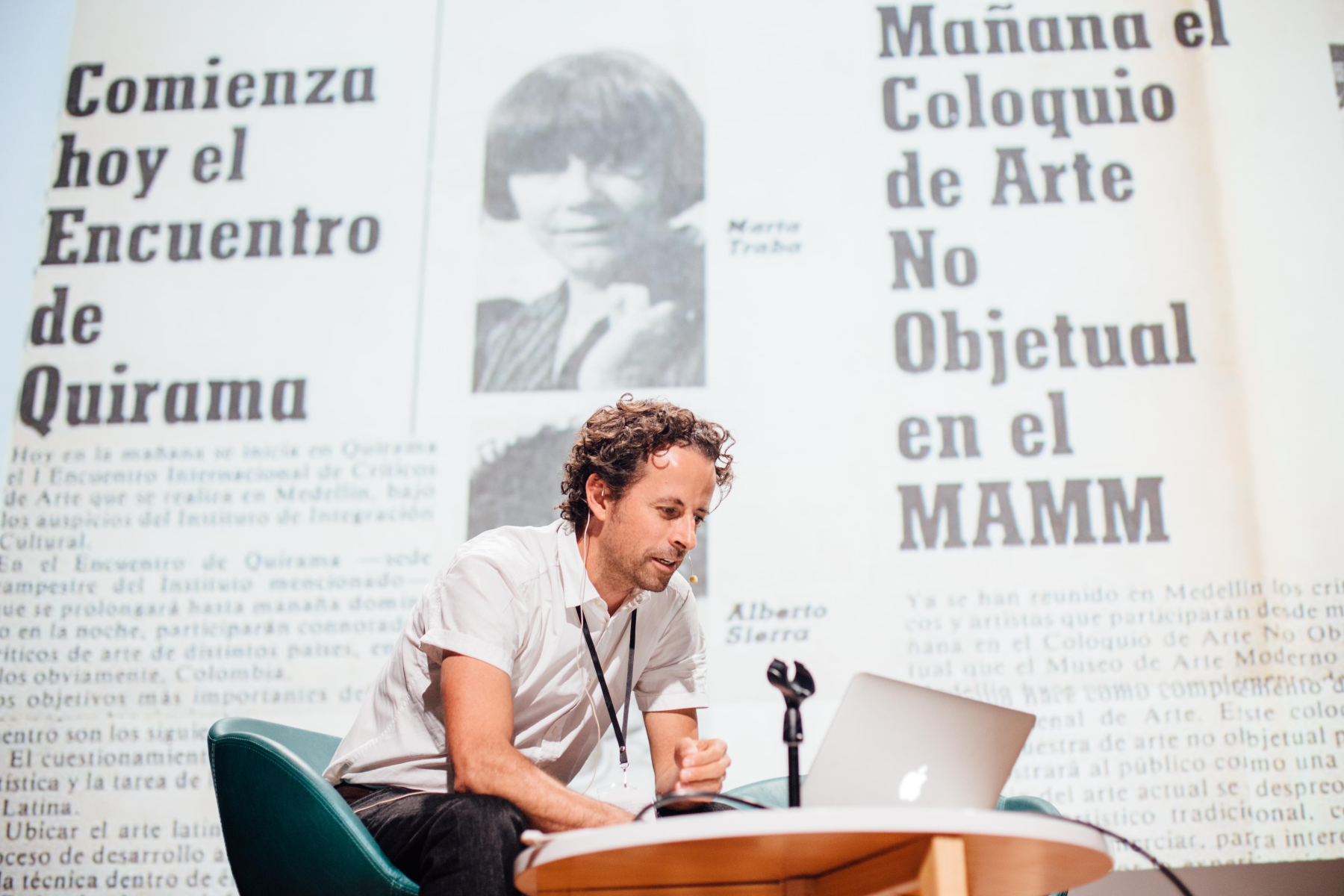
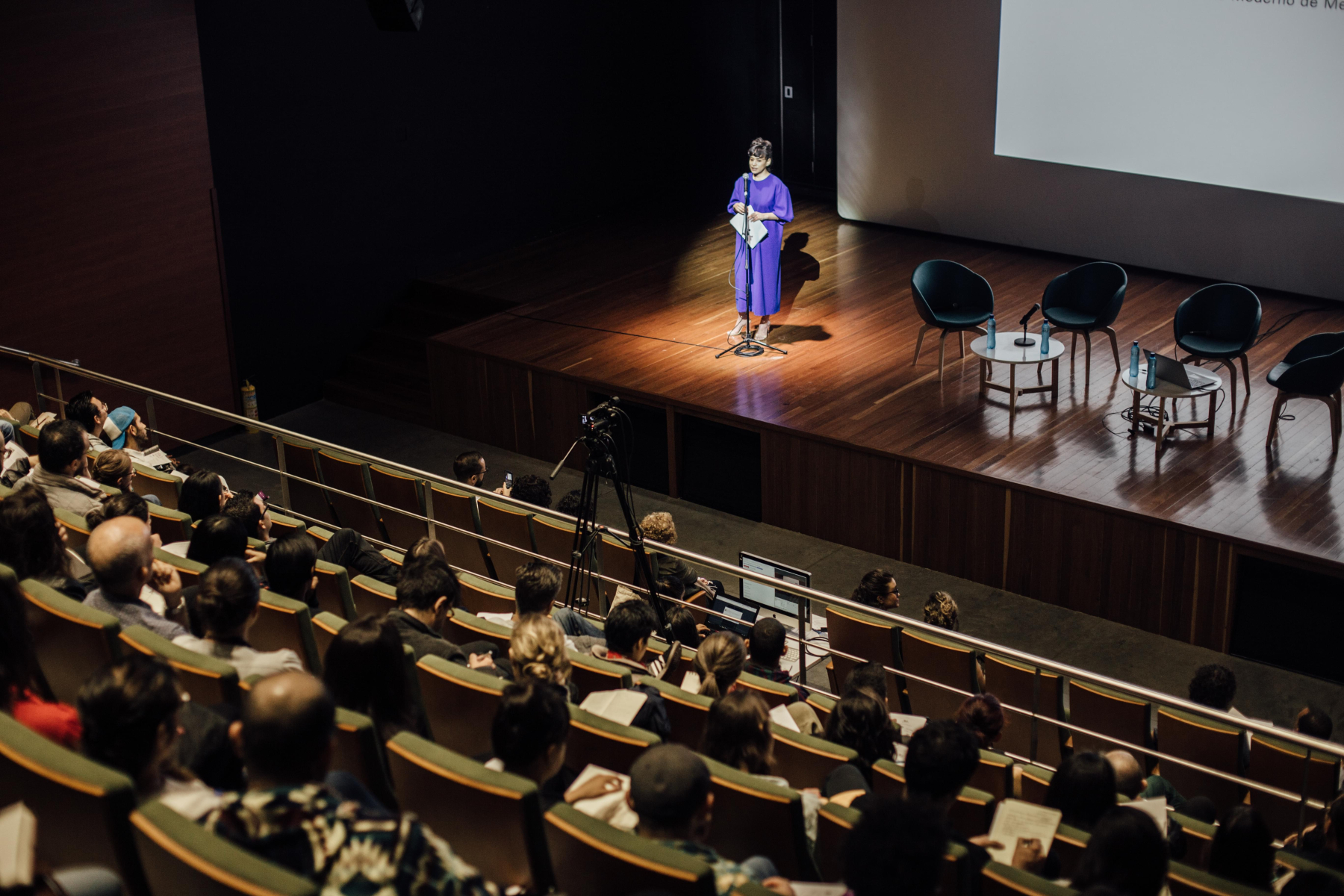
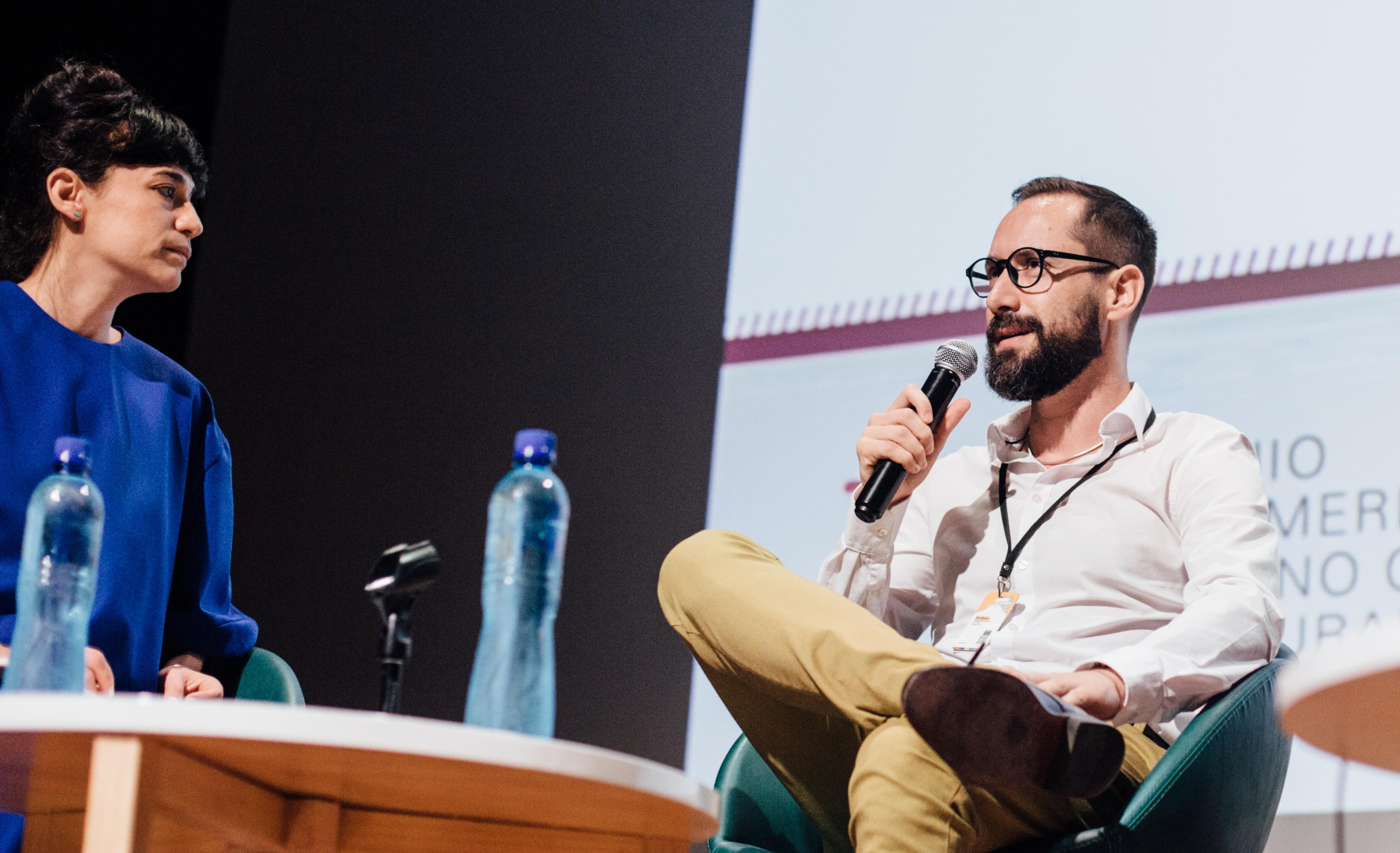
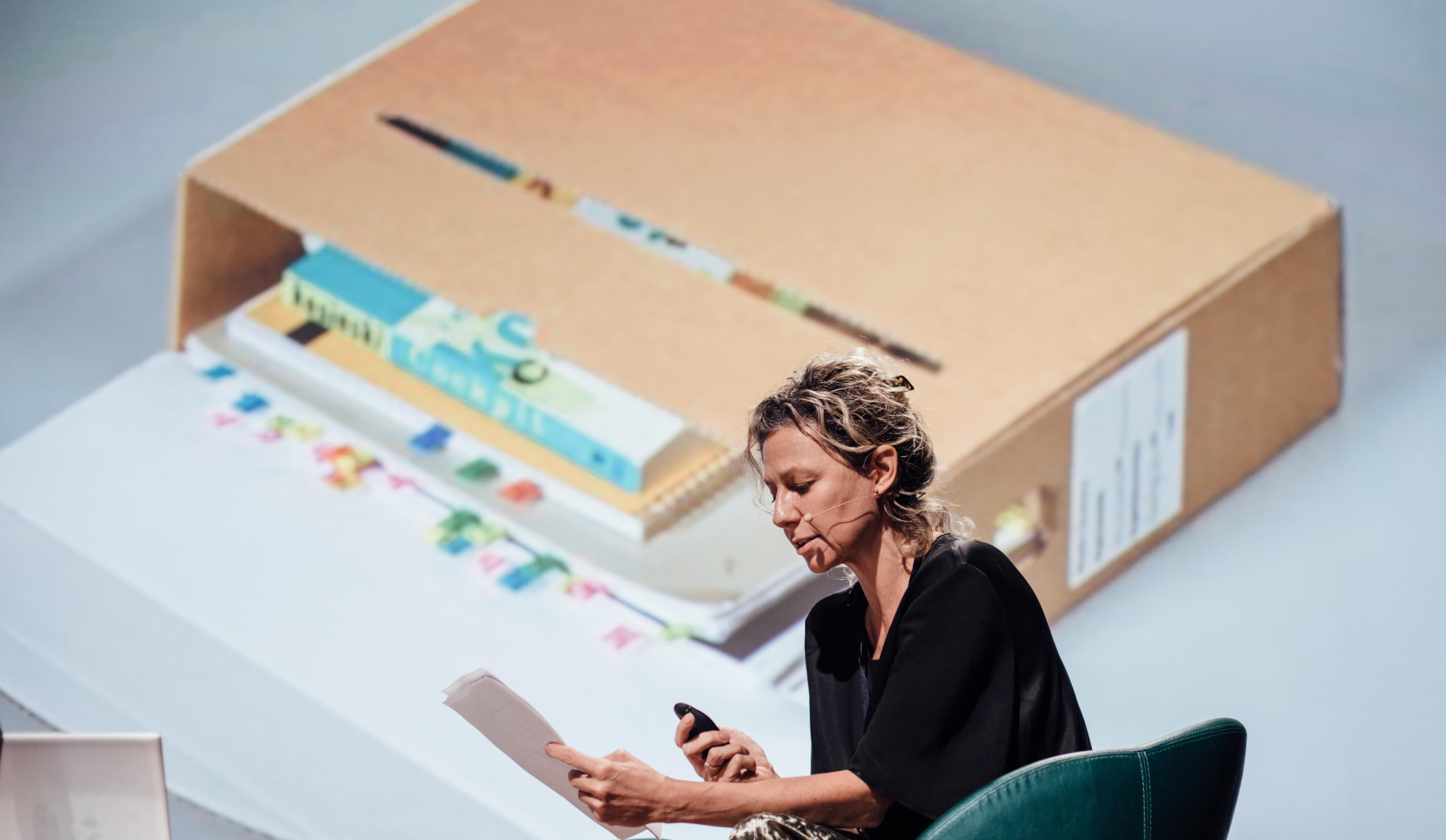
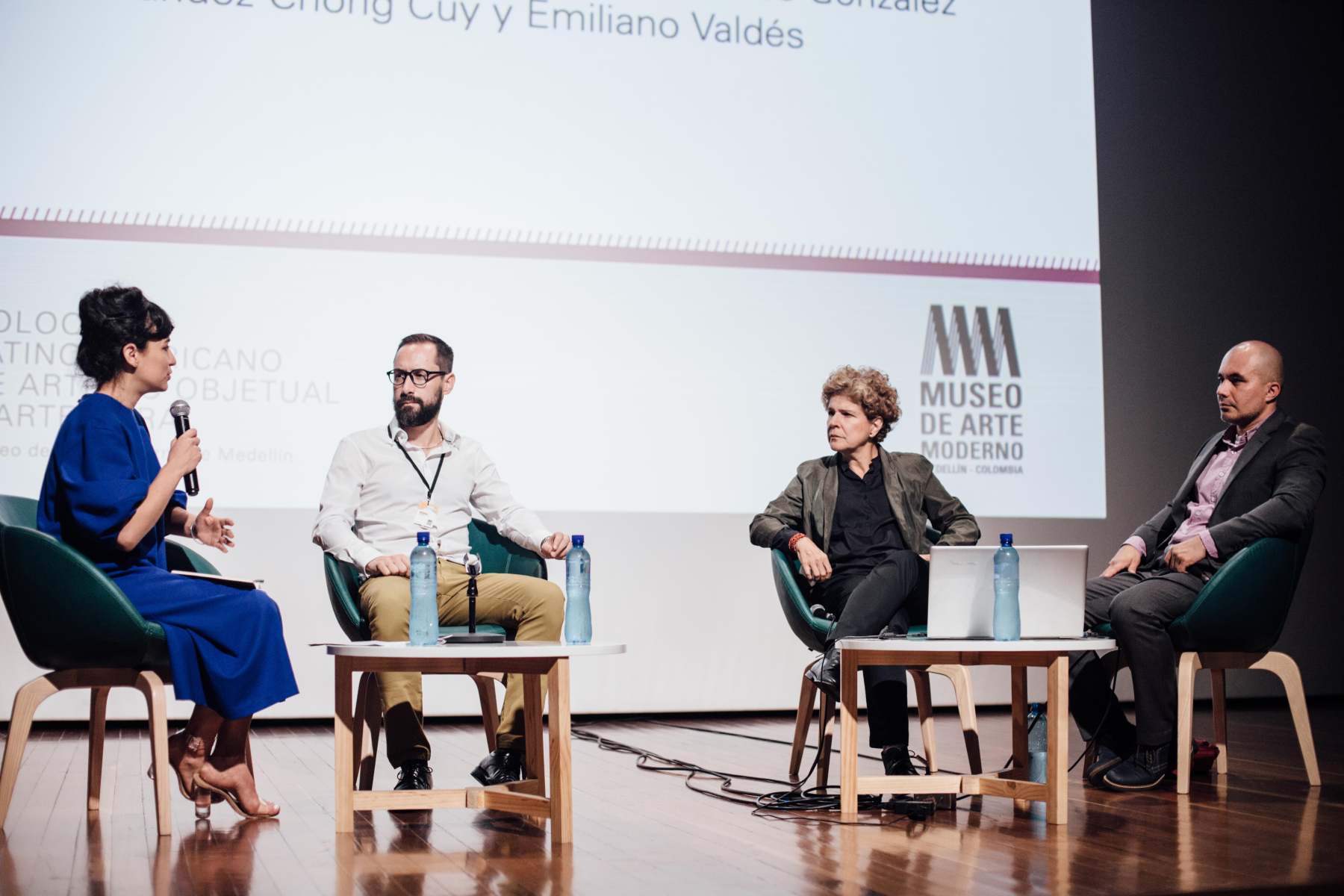
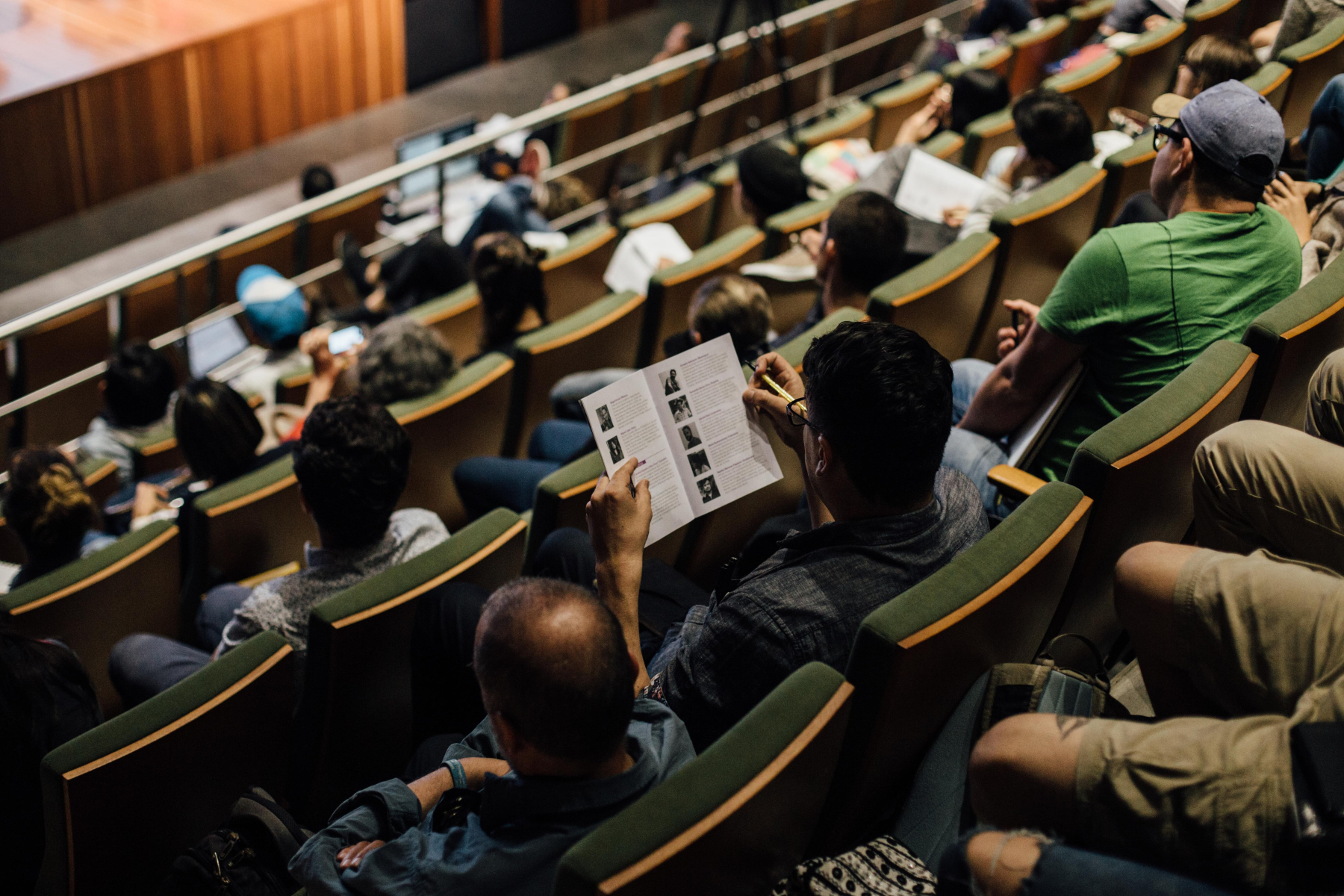
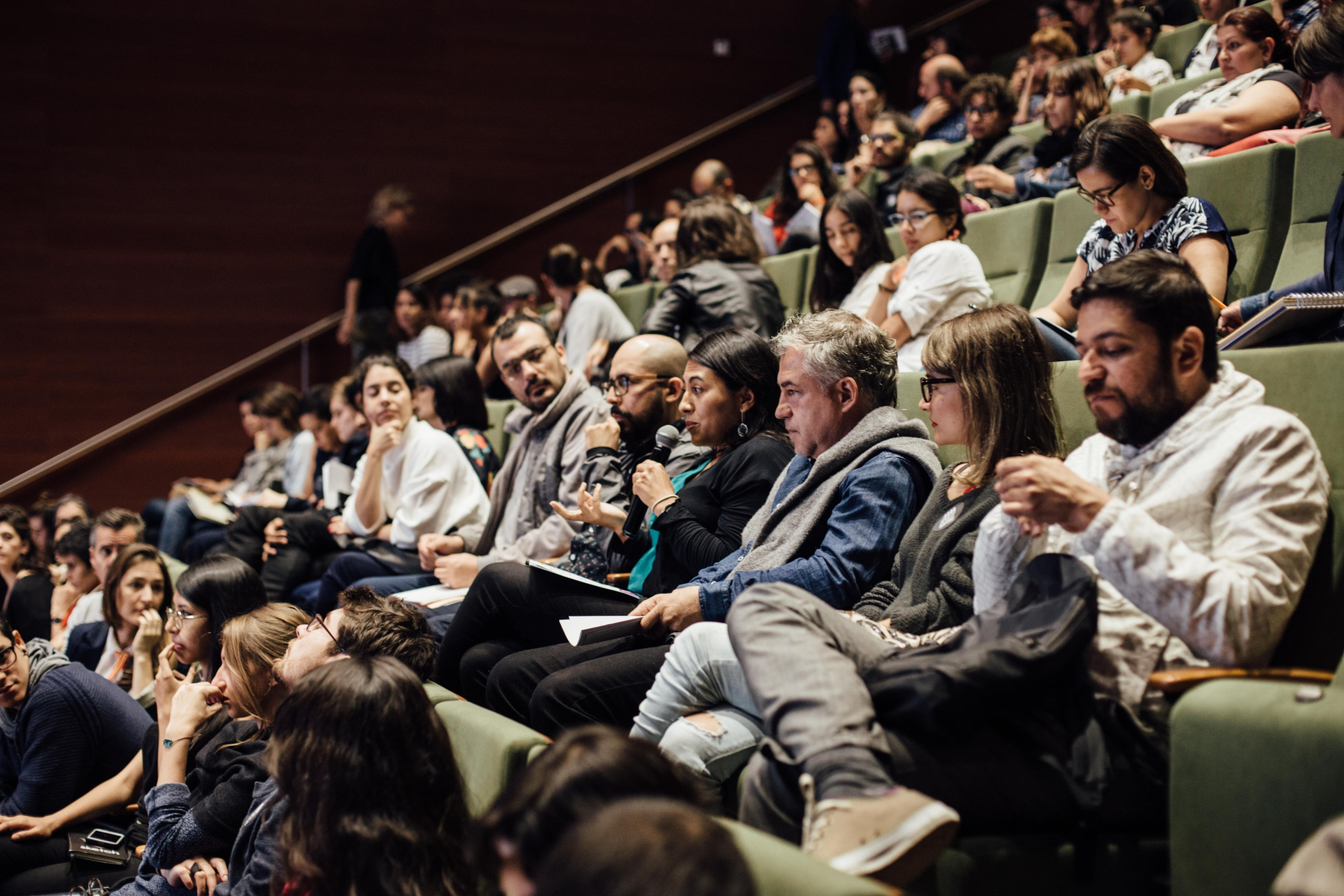
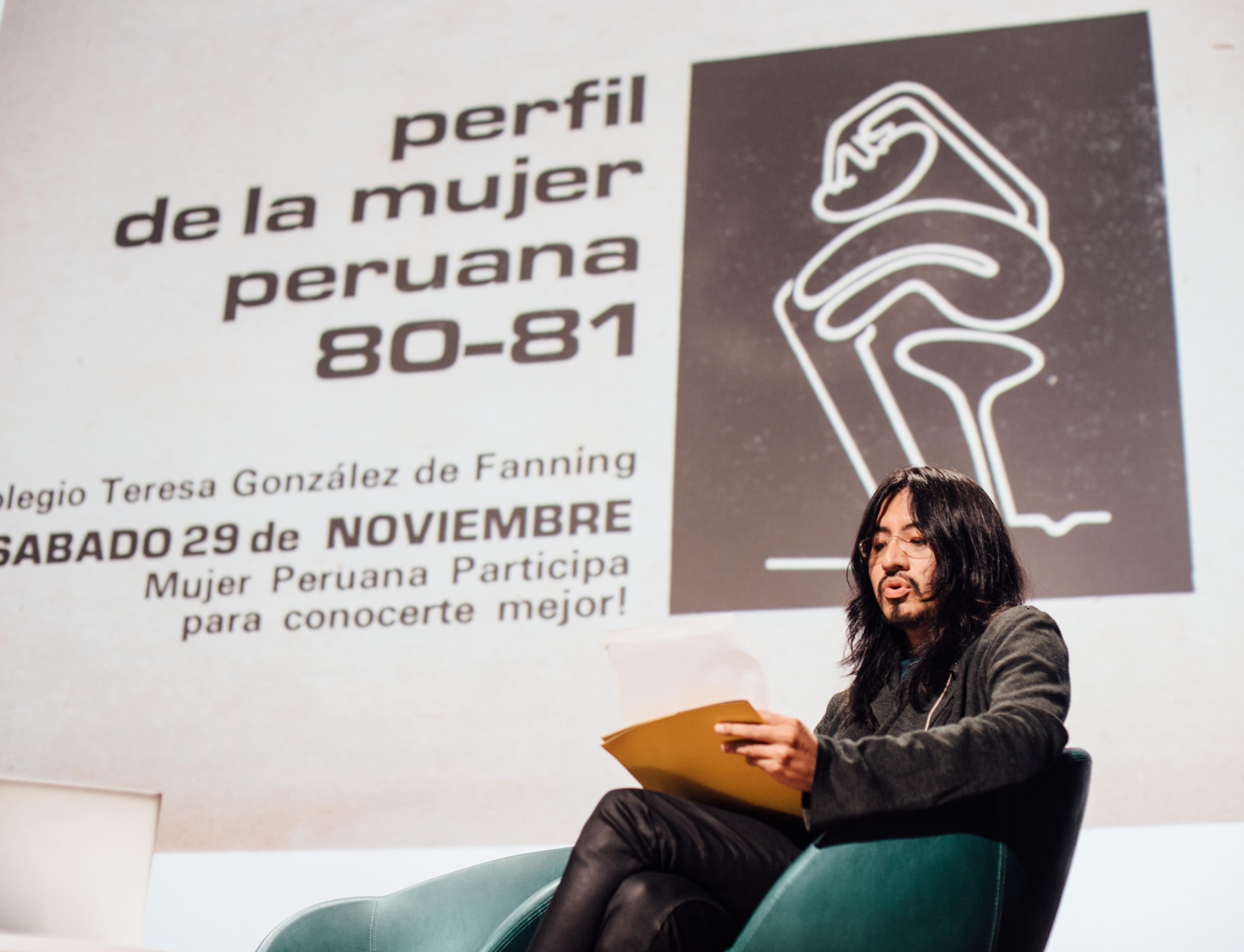
This is how we experienced the Second Colloquium on Non-Objective Art

This event was made possible thanks to the support of the Arví Park Corporation, the Circunvalar Garden of Medellín and Salva Terra.