

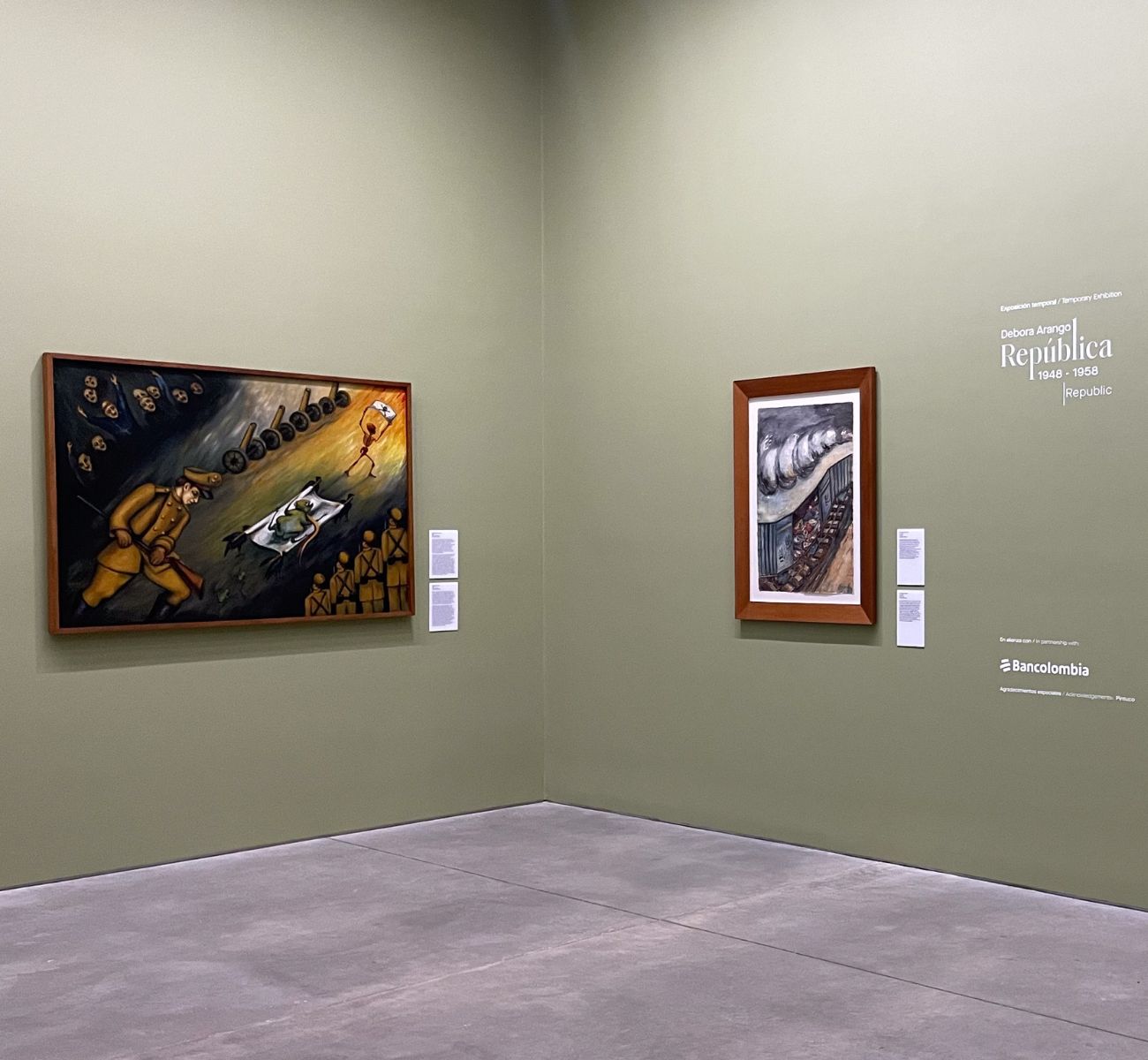
 From 10 de May 2023 al 01 de October del 2023
Débora Arango (Medellín, 1907–Envigado, 2005), a woman and artist from Antioquia, was the first modern female figure in Colombian painting. Still relatively understudied, especially considering her importance in the history of national art and the enduring relevance of her work, Arango produced a body of work that addressed the social, political, and cultural events that defined her era, expressing herself without reservation. A pioneer not only formally but also in terms of her interests and content, the artist also produced “new, distinct, uncompromising feminine poetics” (Cordero, 2011: 366), which in retrospect could be interpreted through a feminist lens, in addition to numerous portraits of family members, friends, and prominent figures in the city.
Throughout her career, Arango created various works that allude to significant historical moments and events in Colombia, revealing the construction of written and narrated history through a critical, feminine lens. Works such as Massacre of April 9 (1948), The Train of Death (1948), Women’s Rights (1954), Student Strike (1954), Melgar (1954), and Doña Berta (1977) recapture moments still present in the collective memory, embodied by the artist with acuity and clarity. By alluding to past events, her paintings serve as catalysts for contemporary concerns through the underlying issues and values of some of the most consequential moments in the country’s history.
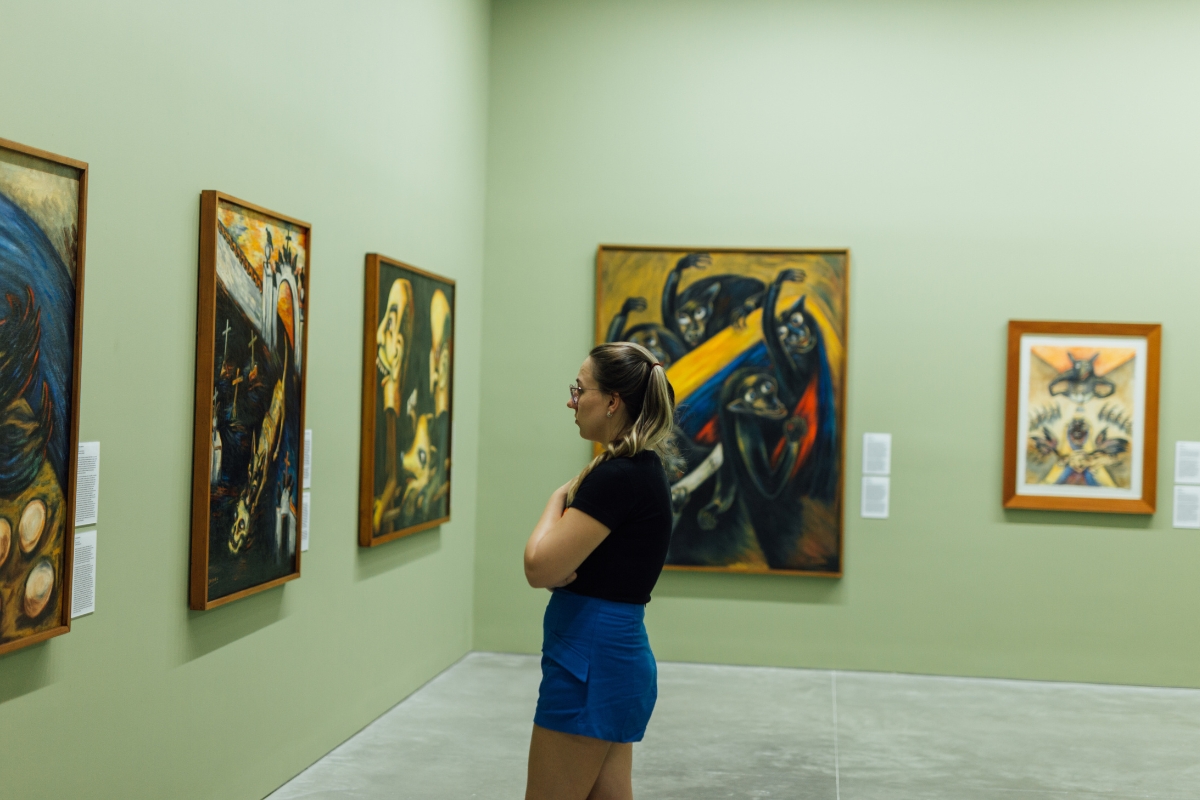
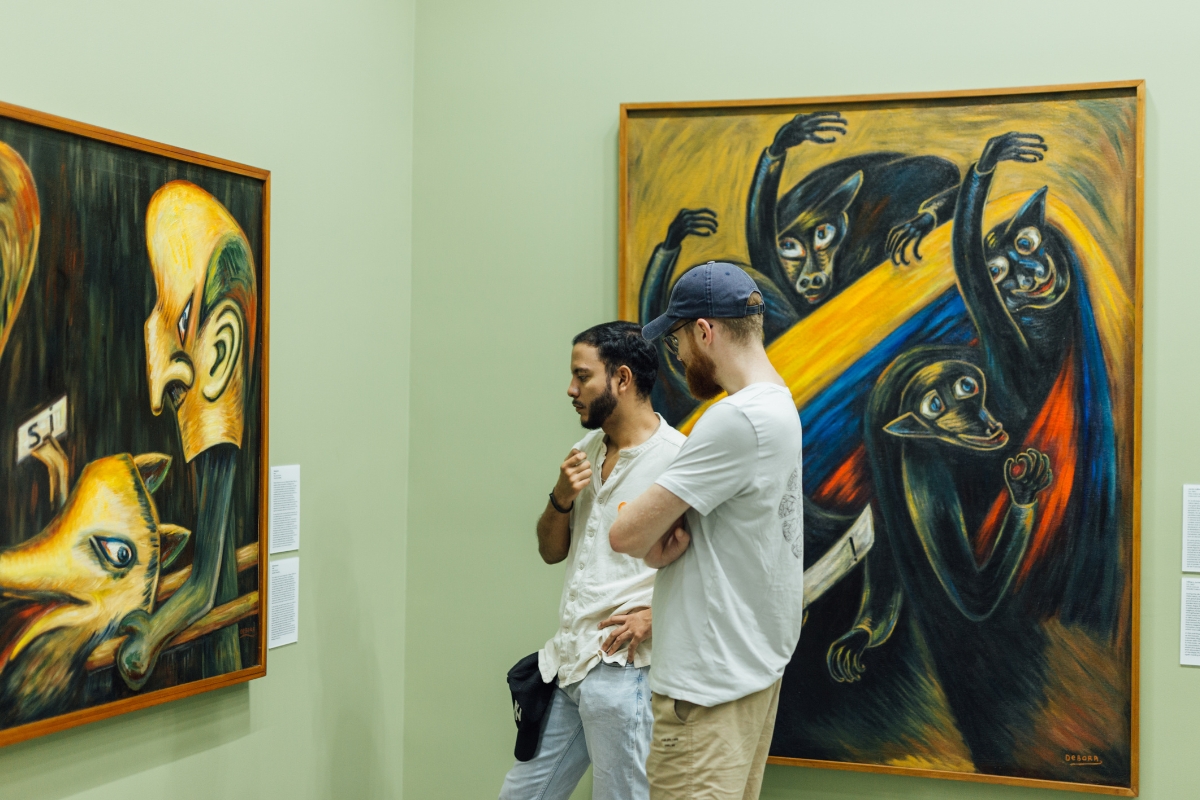
The aversion he felt for certain events and figures translates into an aesthetic of the grotesque, supported by the use of zoological metaphors that imbue the politicians of the day with the derogatory traits associated with certain animals in culture, such as hyenas, birds of prey or vultures, snakes, amphibians, reptiles, dogs, and foxes, among others. This practice, particularly significant in contexts of repression or where freedom of expression has been restricted, draws on the bestiaries characteristic of art history, such as those of Goya (1746-1828), which Arango may have encountered on his trip to Spain, and is further evidenced in the work Rojas Pinilla (1954), as well as in a series of lurid paintings dominated by ugliness.
Débora Arango’s marked interest in political themes emerged with her depiction of the events that unfolded during the Bogotazo, following the assassination of the liberal leader Jorge Eliécer Gaitán, with whom Arango had a close relationship. These events are captured in her work, *Massacre del 9 de abril* (April 9th Massacre). It was Gaitán, as Minister of Education, who had invited her in 1940 to exhibit her work in the lobby of the Teatro Colón. Deeply moved by his death, the artist closely followed the events following the tragic incident through radio broadcasts and processed them in this work. Thus, the theme of La Violencia (The Violence) was not foreign to the artist; it was part of her reality and context, and directly affected her social circle. From this experience and sensitivity emerged other works such as The Dance (1948), The Republic (1957), Rojas Pinilla (1954), June 13 (1953), Laureano’s Departure (1953), The Cemetery of the Rabble and/or My Head (1958), Military Junta (1957), and Plebiscite (1958).
These stances toward life, as well as his particular form of pictorial expressionism, could only be fully appreciated years after his most productive period, when Colombian society developed a different critical perspective on art and a culture distinct from the provincial one of the early 20th century, marked by moralism and conservatism, took shape. Arango’s work carries the force of a frank gaze that manifests as inner movement: the viewer is struck by the brushstroke, the color, the mark, the gesture, the line, but above all, by the content. It is both a communication strategy and a formal exercise, a tension between the narrative and the emotion of a reality still unfolding in the present, as if Arango’s paintings highlighted the fury and the cry of reality.
The connections between the works presented here and the way they weave the history of Colombia from this artist’s perspective are enriched by the social and political movements of the time. Although rendered through the painter’s artistic vision, they allow us to reconstruct the country’s experience through historical, chronicle, journalistic, and conceptual dimensions. This exhibition proposes reading the paintings as if one were reading a text, so that one can enter the realm of time and history. As an exercise in perception, Débora Arango. Republic 1948–1958 suggests that the images be read as chapters of an unfinished story that speak to us as much about Arango’s stance as about the country’s past—and present.
1 “La Violencia is the name given to the Colombian historical period between 1948 and 1953. It was characterized by the harsh confrontations between the Liberal and Conservative parties: political persecutions, assassinations, destruction of private property and terrorism due to ideological alignment” (Roldán, 2012: 13).
Image: Débora Arango, Massacre of April 9 (fragment), 1948.
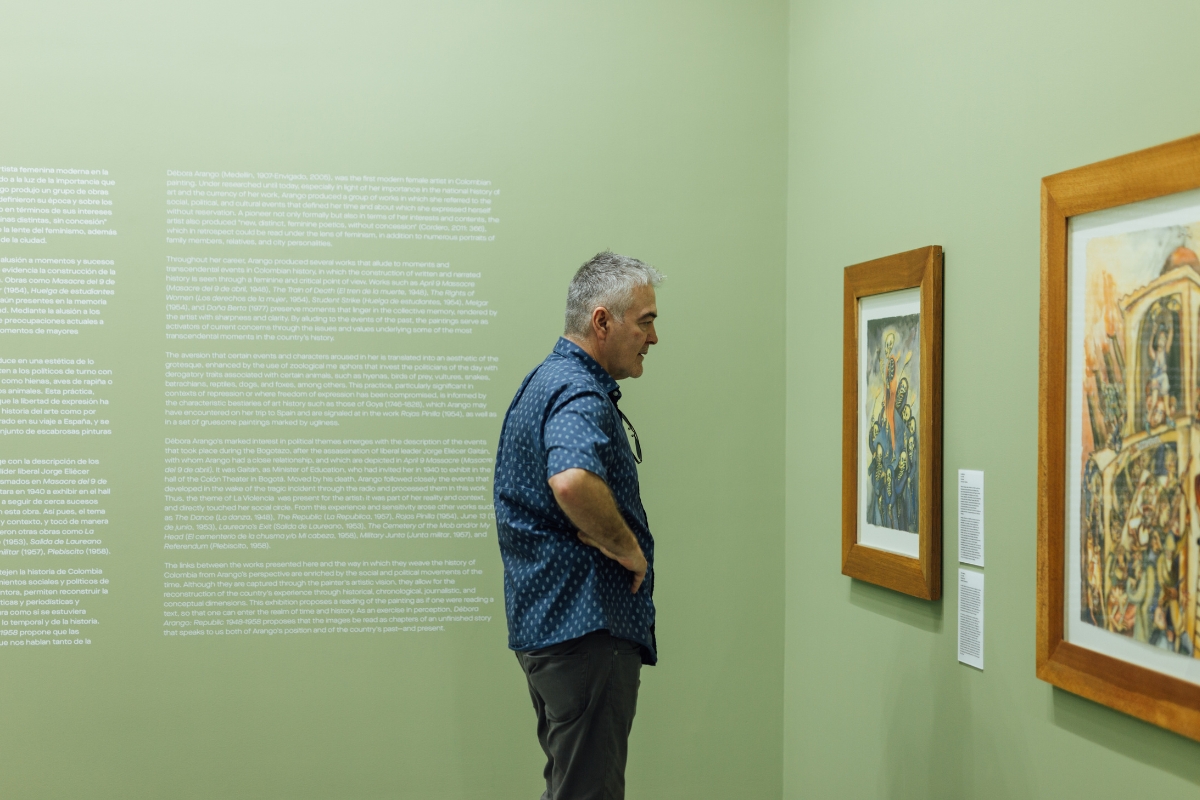
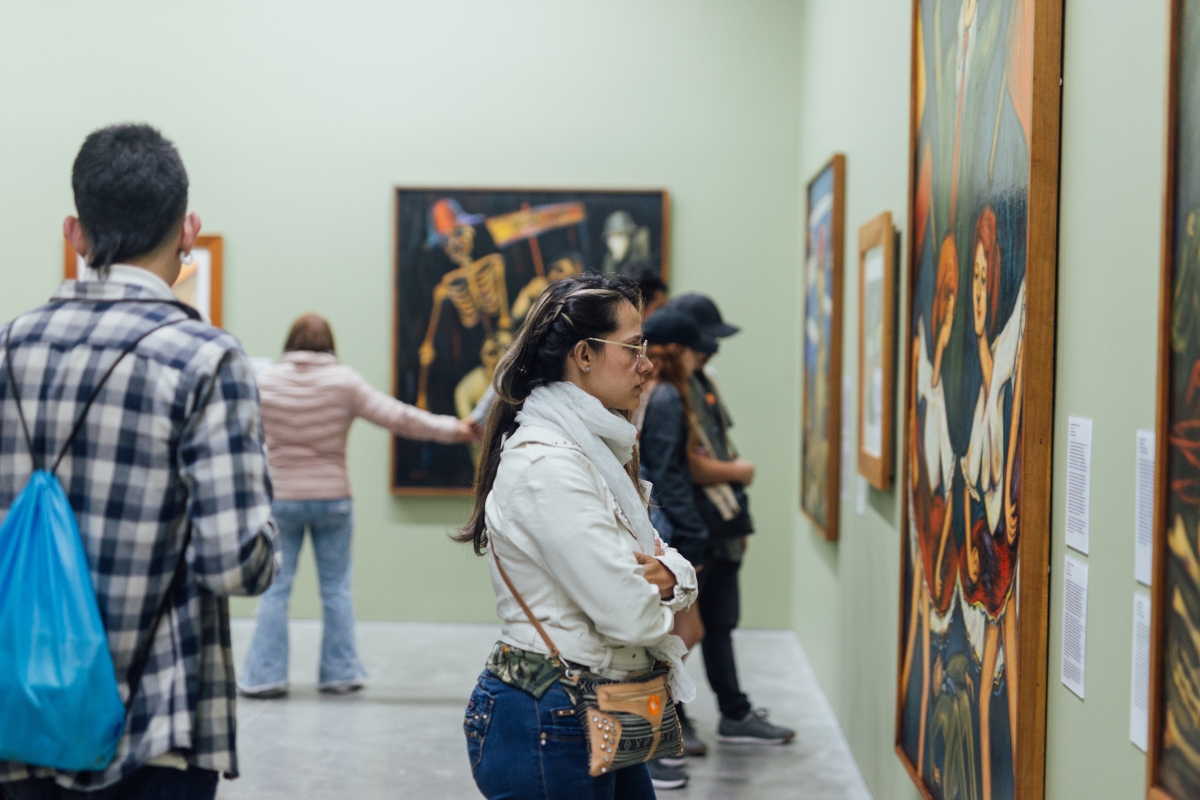
Relive the experience
This exhibition is presented in partnership with Bancolombia