

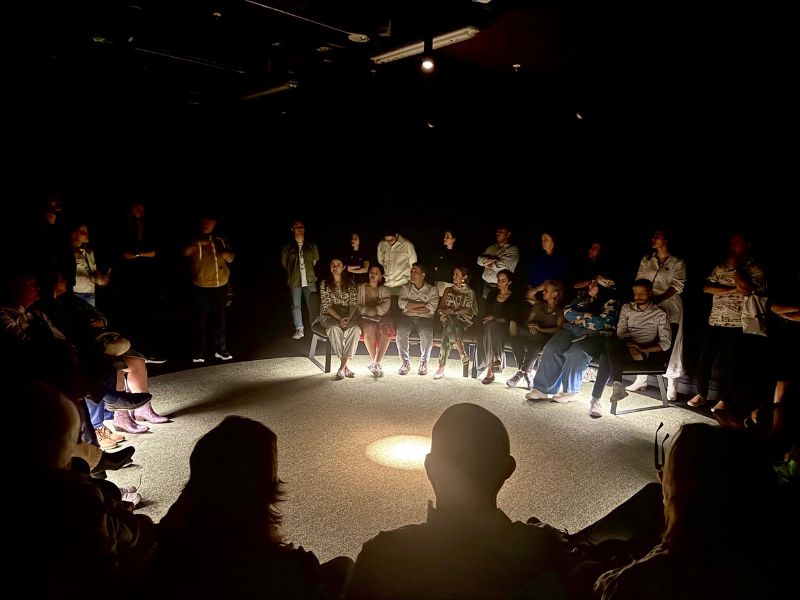
 From 16 of July 2025 to 08 of March of 2026
Artist: León David Cobo
This sound installation invites the public into a dialogue with indigenous languages at risk of disappearing in the Colombian Amazon, through ritual songs, stories, and soundscapes that are, in themselves, living archives of cultures fighting against silence and disappearance.
The recordings that make up Lleébu have been made in collaboration with indigenous communities such as the Kamëntša and Inga of Putumayo; the Korebajᵾ of Caquetá; the Bora, Karijona, Yucuna, Cocama, Nonuya, Muinane, and Yagua of Amazonas; the Jiw, Nukak, and Sikuani of Guaviare; and the Kawiyarí, Pinoamahsa, Kakua, and Sikuani of Vaupés. Each sound recording is a testimony to the linguistic and cultural diversity of these peoples, but also to their ways of relating to the territory.
Recording endangered languages in the Amazon cannot be separated from listening to the territories where those languages live and are spoken. In many indigenous cosmologies, human language is not separate from the sounds of the environment: it is learned from the animals, the rivers, the thunder.
Thus, recording a language also means recording its sonic environment, since the origin is the resonance with nature, the birdsong that resonates with the voices, the dialogues in the maloca that shape ritual speech, the silences that inhabit the moments of oral transmission. Songs and musical instruments also function as bridges between generations, transmitting and safeguarding the collective memory of indigenous peoples.
The exhibition space is designed to foster deep listening, in an intimate atmosphere, with dim lighting that evokes the communal experience of ritual orality. As an interface between the audible and the visible, spectrograms are projected that translate sound frequencies into images, allowing the public to observe the timbral richness of the recorded languages and sounds. In parallel, a screen offers information about the songs and sounds, providing broader access to their meanings.
The installation integrates sound archives from two fundamental projects by the artist León David Cobo: De agua, viento y verdor, an audio library in indigenous languages for children developed with the ICBF, with the support of the Ministry of Culture and within the framework of the De Cero a Siempre program, Fundación PLAN and Fundalectura; and Puerto Asís Sonoro, created together with the Inga community of Putumayo in partnership with the Fundación Batuta and Fondo Acción. To enrich this cartography, in May 2025 Cobo and Jorge Barco (from MAMM’s curatorial team) traveled to Leticia (Amazonas), at the triple border between Colombia, Brazil, and Peru. There, they worked alongside Tránsito Rodríguez, Elvano Miraña, and his family, on listening journeys, recording songs in Nonuya and Muinane languages, as well as soundscapes from the transitional moments between dawn and dusk, and the thresholds between the urban and the jungle. These unprecedented recordings enrich the installation’s sound archive, building bridges between ancestral knowledge and the ways in which these cultural ecosystems persist and transform in the present.
Beyond its aesthetic dimension, Lleébu proposes an ethical and political listening. In the face of the accelerated destruction of the Amazon and cultural homogenization, the project proposes sound as a tool for memory and resistance. Field recording becomes here first and foremost an act of situated listening and attentive presence.
This installation not only amplifies endangered indigenous sounds and languages, but also questions our place as listeners. Are we willing to listen to what these languages and territories still have to say? Lleébu does not offer easy answers, but insists that listening -in its dual dimension of intimate gesture and collective commitment- can be a first step toward reparation.
Acknowledgments:
Elvano Miraña Bora (Traditional name: Igunè, Clan Gavilán), Tráncito Rodríguez Anato (Traditional name: killè Decago, Clan piña), grandfather Arturo Rodríguez Muinane (Traditional name: Noktt Clan Piña), Dulfay Rodríguez Rodríguez (Traditional name: Sicatje. community, Nonuya ethnic group) inhabitants of vereda Xingú, Brazil.
Partner

Institutional partners

