Artists: Jeremy Bailey, Juan Covelli, Damjanski, fabric | ch [Patrick Keller y Christian Babski], Astrid González, Carolyn Kirschner, Vitaly Komar y Alexander Melamid y Nomasmetaforas [Clara Melniczuk y Julian Dupont]
Modernity was characterized by profound transformations in society that, driven by industrialization and urbanization, often resulted in a sense of alienation for individuals. This period, spanning from the late 18th century to the mid-20th century, was grounded in the postulation of universal truths and modern “grand narratives.” Alongside them, there was an emphasis on rationality, reason, and scientific knowledge as guiding principles for progress.
Its ideals emerged as a response to technological advances, social changes, and the secularization of authority, shifting the center of social structure from religions toward progress and innovation. However, the arrival of information technologies in the second half of the 20th century challenged these foundational narratives, exposing their limitations and provoking critical responses in the form of postmodernism, non-modernity and extra-modernity, which sought to reassess or transcend the frameworks of modernist thought.
Postmodernism, described by Jean-Francois Lyotard in the 1970s, proposed the possibility of fragmented and decentralized knowledge, driven by the development of information technologies. This break with modern universality was reflected in the exhibition Les Immateriaux (1985, Centre Pompidou, Paris), curated by the French philosopher, which employed a labyrinthine and disorienting exhibition design to embody the postmodern condition and its multiplicity.
Subsequently, the French sociologist and philosopher Bruno Latour challenged modernity’s reliance on binary oppositions to describe reality, such as human versus non-human, with his seminal book We Have Never Been Modern (1991). Instead, he proposed a perspective that dissolves the division between nature and culture called “non-modernity.” The exhibition Iconoclash: Beyond the Image Wars in Science, Religion, and Art (2002, ZKM | Karlsruhe), curated by Latour and Peter Weibel, explored this negation, focusing on the tension between the destruction and creation of images in science, art, religion, and politics. Iconoclash presented a wide range of artifacts that critiqued modernity and its legacy.
At the turn of the 21st century, Brazilian anthropologist Eduardo Viveiros de Castro developed the concept of extra-modernity, through which he critiques the limitations of modernism and postmodernism. His approaches trace an alternative to surpass these frameworks, emphasizing ontological pluralism and the coexistence of multiple cultural perspectives to reject the universalization of modernity and the relativism of postmodernism.
Within this trajectory, Lyotard and Latour used their exhibitions to interrogate the foundations of modernity, engaging the public in profound philosophical and cultural debates. For this reason, the starting points of this exhibition are the digital models of the iconic exhibitions Les Immateriaux and Iconoclash, generated from the in-depth study of documentary vestiges and the critical reflection that these shows produced at the time. Complementarily, contemporary reflections, and therefore the exit routes from modernity, are provided by artists who model and interpret works of art, rituals, and cultural processes through diverse technological media, offering a perspective from our contemporaneity.
Thus, the exhibition presents projects by Jeremy Bailey, Juan Covelli, Damjanski, fabric | ch, Astrid Gonzalez, Carolyn Kirschner, Vitaly Komar with Alexander Melamid, and Nomasmetaforas.
Institutional critique is exercised in the augmented reality application The Perfect Museum by Jeremy Bailey, which fosters interactivity and, at the same time, deliberately seeks to disconcert. Due to the malleability of digital material, even the body can become an exhibition space. The artist creates an environment in which the body itself becomes the base of the museum, thus blurring the boundaries between subject and object, institution and visitor.
The institutional critique of colonial museums from a digital restitution perspective is the focus of the video installation Sahumado by Astrid Gonzalez. The work constitutes a symbolic and aesthetic proposal for repatriation in which digital objects are invested with the symbolic value of physical objects stored in the warehouses of foreign museums.
Increasingly defined by digital production, museums become tangible elements of planetary-scale computation. Based on this omnipresent digital infrastructure, the AR application Never Not There by Damjanski presents visitors with dystopian images generated when they point their camera at a black square, referencing one of the most iconic abstract paintings of the 20th century, Black Square by Kazimir Malevich.
The critique of modes of representation, specifically political propaganda, is the subject of Untitled Installation (Statue Dangling from a Crane), a performative work by Vitaly Komar and Alexander Melamid that suspends a communist monument. AR Statue Dangling from a Crane is a digital interpretation of this work, featuring a sculpture of Lenin.
Monuments play a central role in the series Los Caidos by Juan Covelli. Inspired by the 2021 national strikes in Colombia, the simulated society of Los Caidos depicts a variety of characters clashing with governmental forces in battles incited by algorithmic culture. The project presents photogrammetries of the monuments demolished during the protests.
Digitized artworks are the central axis of Carolyn Kirschner’s video, which uses models of works presented in the exhibition Iconoclash, multiplying or deconstructing them and emphasizing the false materiality of digital copies. The movement of the digital objects and the accompanying sound in Iconoclash Slow Squeeze can trigger Autonomous Sensory Meridian Responses (ASMR).
If the scenography of Les Immateriaux was a thesis and Iconoclash its antithesis, the installation Atomised (Re-)Staging by fabric | ch could be understood as a synthesis. Based on 3D models representing the works and objects of the two previous exhibitions, an elusive algorithmic fusion of past assemblages anticipates a processual digital future for exhibition-making.
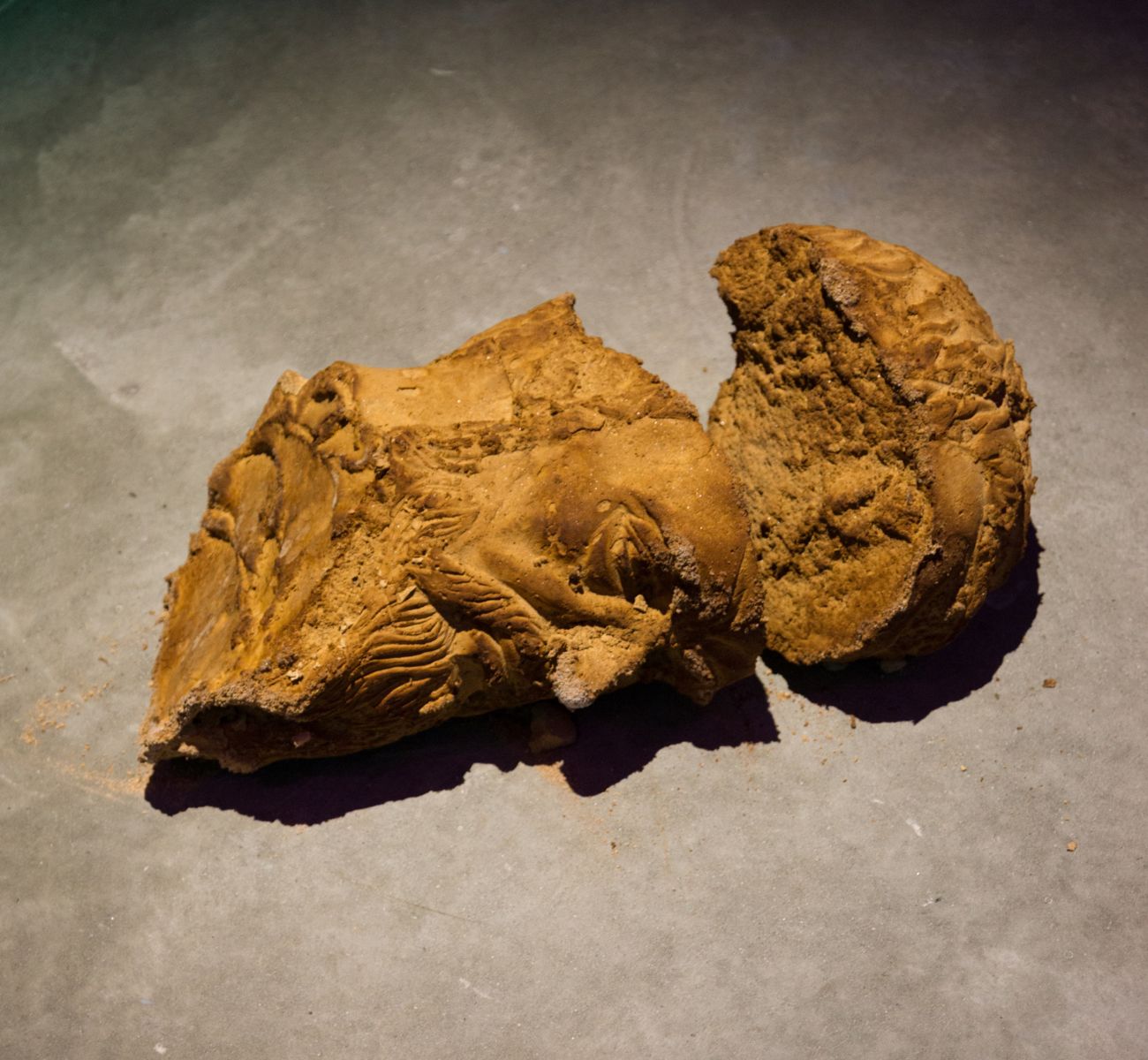
In resonance with the concept of extra-modernity, the installation Potosi, la ensonacion de la montana inversa by Nomasmetaforas, made with black earth, coca leaf, yarumo powder (MAMBE), and magnets, juxtaposes indigenous perspectivism with critiques of digital technology infrastructure. In connection, Tecnologias Colectivas del Sueno is a collective sleeping encounter in which participants gather to explore the possibility of virtuality in relation to ancestral signaling techniques.
These works expand and add to the body of knowledge that occupied the spaces of the two historical exhibitions. They engage with contemporary methods of exhibition-making, increasingly defined by digital production.
An extensive program will accompany the exhibition, including presentations by the participating artists and lectures by researchers at the 5th MAD Academic Seminar.
This exhibition, under the title Matter, Non-Matter, Anti-Matter. Past Exhibitions as Digital Experiences, was presented in 2022-23 at the ZKM | Center for Art and Media Karlsruhe. A reinterpretation of the show was exhibited in 2023 at the Centre Pompidou in Paris. These two institutions developed the digital exhibition models within the framework of the practice-based research and international cooperation project Beyond Matter: Cultural Heritage on the Verge of Virtual Reality (2019-23).
At the MAMM, the exhibition is presented in conjunction with the research-creation project Matter 3 Colombia, which includes two other simultaneous exhibitions at Casa Morada and the La Salle Museum of Natural Sciences, as well as a third digital exhibition model developed at the ITM. Together, these initiatives create a dialogue between spaces and perspectives on the relationship between art, technology, and cultural heritage.
An alliance with
Patrocina
Apoyan
Institutional ally
Project allies


