

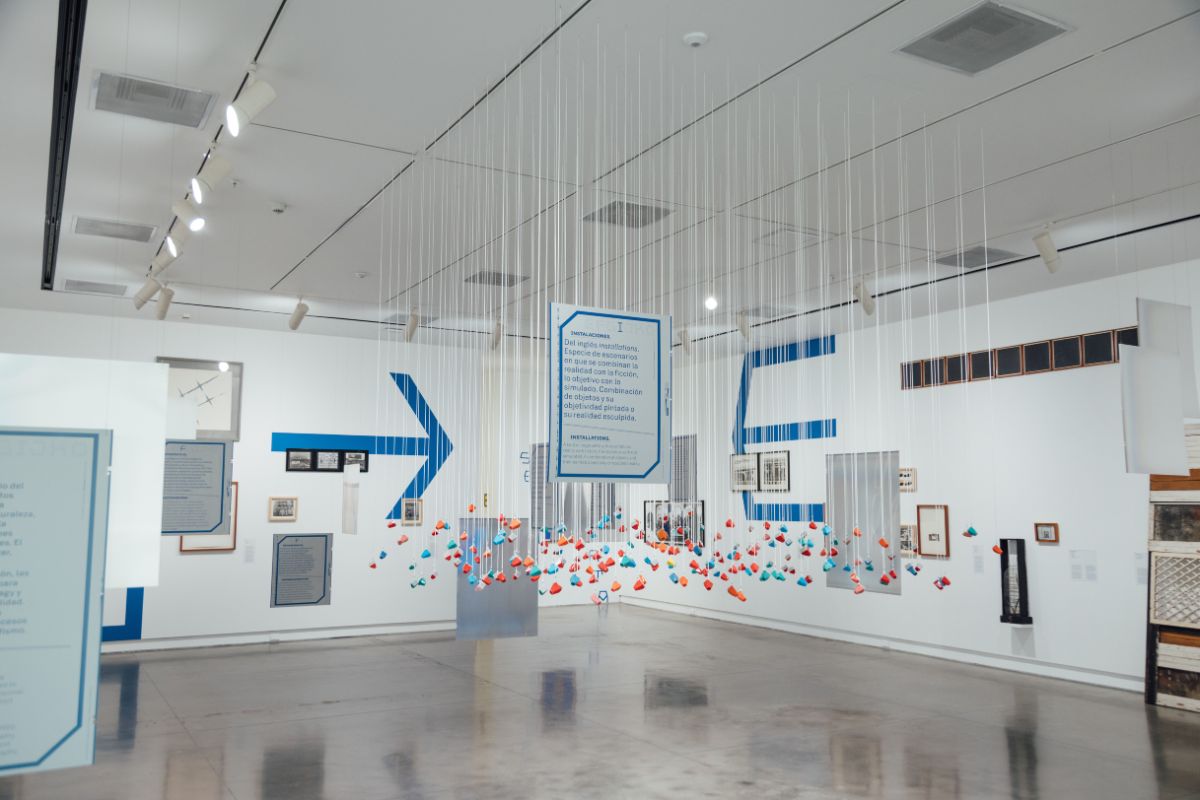
 Galleries E, F and G
 From 21 of August 2025
Artists: Adolfo Bernal, Álvaro Herazo, Ana Claudia Múnera, Antonio Caro, Armando Londoño, Armando Montoya, Beatriz González, Beatriz Jaramillo, Becky Mayer, Bernardo Salcedo, Bill Viola, Bridget Godfrey, Camilo Moreno, Carlos Echeverry, Carlos Gómez, Carlos Rojas, CAYC, Clemencia Lucena, Débora Arango, Diego Barbosa, Don Little, Edith Arbeláez, Eduardo Posada, Enrique Álvarez, Efraín Arrieta, Ethel Gilmour, Eugenio Dittborn, Félix Ángel, Fernell Franco, Gego, Germán Martínez, Gertjian, Bartelsman, Gloria Patricia Orrego, Gustavo Sorzano, Heidi Klein, Ida Esbra, Javier Betancourt, Javier Cruz, John Jairo Correa, Jonier Marín, Jorge Ortiz, José Alejandro Restrepo, Juan Camilo Uribe, Juan Carlos Restrepo, Juan Luis Mesa, Julián Posada, Julie Clucas, Liliana Porter, Lope Max Díaz, Lotty Rosenfeld, Luz Elena Castro, Margarita Paksa, Margarita Tamayo, María Teresa Cano, Mariano González, Mario Hernández, Mantilla, Marta Elena Vélez, Marta Minujín, Maryluz Álvarez, Mathias Goeritz, Michal Shabtay, Miguel Ángel Noya, Natalia Restrepo, Ofelia Rodríguez, Omaira Abadía, Óscar Monsalve, Otto Apuy, Patricia Bonilla, Raúl Marroquín, Ramiro Gómez, Rolando Peña, Rosa Navarro, Sergio Trujillo Dávila, Silvia Patiño, Tina Samper, Ulises Carrión
These experimental artistic practices found a space of convergence from the early 1980s onward in events promoted by the MAMM (Museum of Modern Art of Medellín), such as the Video Biennials (1986-1992), the Arturo and Rebecca Rabinovich Salons (1981-2003), and the First Latin American Colloquium on Non-Objective Art and Urban Art (1981). The archive of these events encompasses a variety of documents, including correspondence, artists’ portfolios, sketches, protocols, and records of works that were accepted or rejected in the exhibitions. This exhibition proposes a review of pieces that move between the notions of document, artwork, and record, based on the reinterpretation of documentary archives, publications, press clippings, installation studies, and writing experiments.
The exhibition is divided into four sections, each named after a protest exhibition project developed in Colombia during the 1980s. [1] From Page to Space: This section comprises works that explore the complexities of two-dimensional and three-dimensional space. It includes projects that lie at the intersection of the image as document and the image as a creative process. Some works explore the limits of photography as a plastic tool. [2] Plural Attitudes: This section presents non-objective projects and practices linked to political, conceptual, and experimental processes. It brings together artists who use the body explicitly or implicitly in ephemeral actions. Many of these projects had a participatory character that challenged the barriers between artist and public. [3] Paper and Pencil: This chapter explores the development of mail art in the country through exhibition and publishing projects linked to networks of artists in the region. [4] Audiovisual 1: This section brings together projects in magnetic media or their graphic translations, which expanded the notions of video as a medium for visual and sound experimentation.
Open Signal: Languages of Contemporary Art shares the pedagogical character of Leonel Estrada’s 1985 project and invites the public to suggest new ways of naming what they see inside and outside the Museum. Which work would you use to define the concept of automatism included in the dictionary?
Institutional allies


Support
