

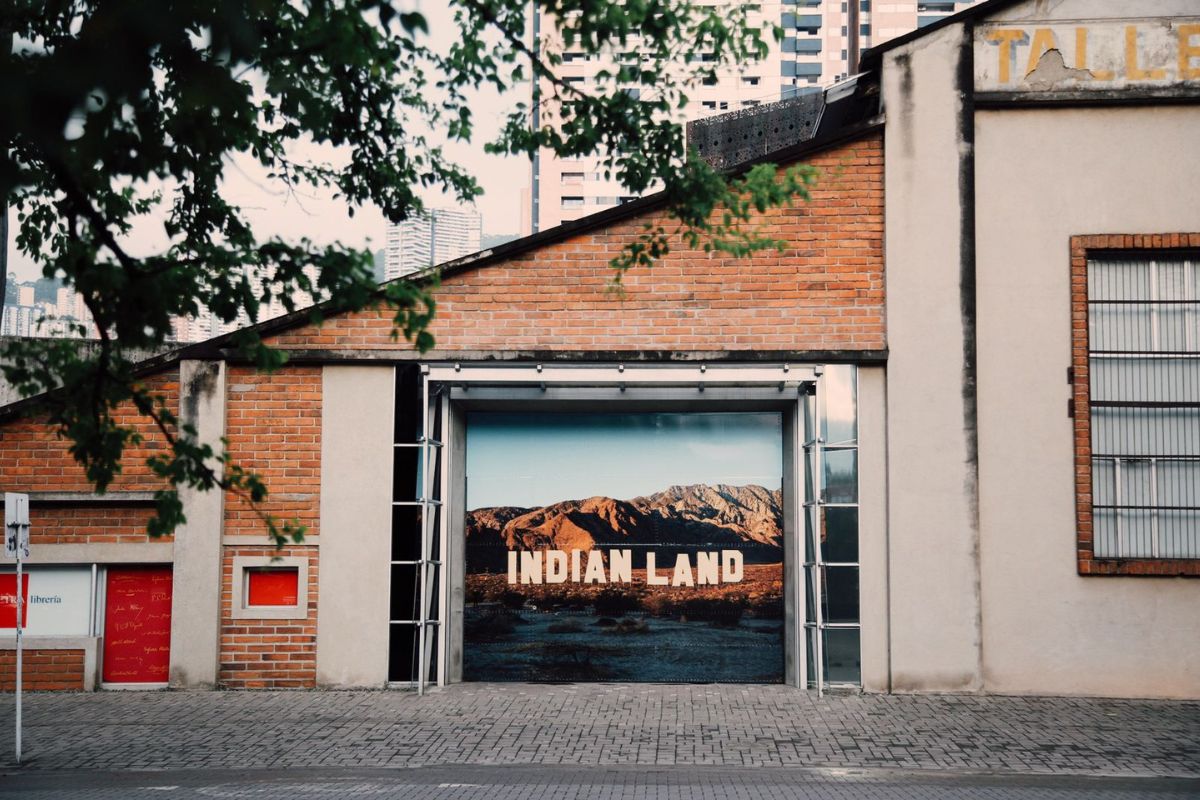
Opening of six exhibitions and the gathering El espacio en medio: art, dialogues, and performances
Wednesday, October 2, 2024, 11:00 a.m. to 9:00 p.m.
Free admission with voluntary contribution
Thursday, October 3 and Friday, October 4. Admission with ticket purchase at the box office
We invite you to be part of the opening of six new exhibitions this October 2 from 11:00 a.m. to 9:00 p.m., with free admission and voluntary contribution.
Discover El espacio en medio, an international exhibition that explores the connection between indigenous peoples and topics such as the relationship between the skies, the earth, and water; Angela Maria Restrepo. Nada se puede duplicar realmente, an intimate reflection on life and death through printmaking; Khoka Project, a collective and interdisciplinary investigation of the coca plant; No-objetualismos. Hacia un pensamiento visual independiente, which examines the development of contemporary art in Latin America; Huellas de aire, a sound installation that connects air with our emotions; and Correspondences, an artistic collaboration between Soundwalk Collective and Patti Smith.
This event not only marks the opening of these six exhibitions but also opens a dialogue around urgent topics such as the recognition and survival of indigenous peoples. In a city like Medellín, where the confluence of cultures and the history of resistance are so important, El espacio en medio offers a unique opportunity to reflect on land management and the deep connection between ancestral communities and their environment. This gathering becomes a vital space to rethink forms of coexistence in a global context marked by climate change, extractivism, and the struggle for the rights of indigenous communities.
Additionally, this day will be the first of a series of encounters, conversations, and performances revolving around the exhibition El espacio en medio. Do not miss the opportunity to participate in an agenda full of cultural activities that will extend through October 4. Conversations in English will have simultaneous translation into Spanish.
Schedule:
Wednesday, October 2. Free admission.
This dialogue is part of what we understand as ‘the unrolling of time in a spiral,’ which consists of setting in motion across other geographies and times the ways in which the creative act and the languages of sensitivity have been accompanied from the ancestral principles of our territories. It is an Espacio en medio to share a word as Daughters of Water, critical toward the dissemination of coloniality in our bodies/territories; individual yet always collective challenges and demands, from our perspective; a form of encounter, consultation, collective human and non-human reflection to make agreements; settings where one learns the way of living, healing, and being born that is proper to the Andes mountain range.
About the Consejo Ancestral Willka Yaku (Jenniffer Avila Jordan –Phuyu Uma–, Eyder Calambas)
Descendants of the original peoples of the Valle de Puben (Department of Valle del Cauca and Cauca), the Afro tradition, and the Guanano people of Mitu, who accompany and are guided by the elders of the ethnic peoples, their knowledge systems, and the greater spirits of their territories. Walking from there toward the strengthening of the bond with the Planet, an organic decoloniality of memory, of struggles, of individual and collective creative processes (culture); chewing coca and reflecting on life, recognizing the structural origins of colonial wounds and healing them through the natural weaving of the Runa-Human Being with environmental and social cycles, a relevance that positions them globally in the face of the crises our Jallapamama-Mother Earth faces.
The curators of El espacio en medio will discuss the curatorial process and the ideas behind the exhibition through the work of some of the invited artists.
Minor Gestures is a collective made up of Alejandro Bernal, Bhenji Ra, Brian Fuata, Ballroom Medellín, and Carlos Andres Jaramillo. Performance curator: Paschal Daantos Berry.
About Bhenji Ra
Bhenji Ra is a Filipino-Australian artist working at the intersections of dance, video, and community activation. Rooted in trans-intercultural and intergenerational practice, her work addresses the invisible narratives of society, seeking to offer new, decolonial, and fugitive possibilities of community and becoming. Guided by both her queer and cultural genealogies, she weaves vast tapestries of ritual, archive, and collective action that are nourished by the intersections and intimacies of her life.
About Brian Fuata
Brian Fuata works with performance, film, installation, email and SMS messages, social media, and print. His practice in structured improvisation is “performance mediation” based on reading the physical, social, and relational characteristics of a given place and context, in order to express them in his events — both digital and live.
Thursday, October 3. Admission with ticket purchase at the box office.
About Ashley Perry
He is a Goenpul artist from the Quandamooka Nation, in southeast Queensland, Australia. He has worked in the university and cultural sectors over the past decade, and his research interests focus on repatriation histories within Australia and internationally, and on historical collection practices used by universities and museums. Perry also teaches in the programs of the School of Art and the Victorian College of the Arts at the University of Melbourne.
Since the creation of the First Nations Directorate in 2021, Powerhouse has been working to enable and respect the right of reply of indigenous peoples, improving, updating, and correcting the interpretations of their cultural heritage in collections previously assembled by outsiders. This is a method of rehumanization and inclusion of stories that have incurred in what Michelle Caswell calls symbolic annihilation. An example of this is the response of Wayilwan communities to the 1898 photographic negatives of Wayilwan men taken by Charles Kerry for a series of postcards that attempted to eroticize and did not understand the cultural practices they witnessed, and which have since been considered a relic of the past rather than documentation of a living culture.
About Nathan “mudyi” Sentance
He is a cis Wiradjuri librarian and museum collections worker who grew up on Darkinjung Country. Nathan currently works at the Powerhouse Museum as Head of First Peoples Collections and writes about history, critical librarianship, and critical museology from a First Peoples perspective. His writings have previously been published in The Guardian, British Art Studies, Cordite Poetry, Sydney Review of Books, and on his own blog The Archival Decolonist.
Powerhouse acknowledges the traditional custodians of the ancestral lands on which our museums are located. We respect their Elders, past, present, and future, and acknowledge their ongoing connection to country.
Minor Gestures is a collective made up of Alejandro Bernal, Bhenji Ra, Brian Fuata, Ballroom Medellín, and Carlos Andres Jaramillo. Performance curator: Paschal Daantos Berry.
About Bhenji Ra
Bhenji Ra is a Filipino-Australian artist working at the intersections of dance, video, and community activation. Rooted in trans-intercultural and intergenerational practice, her work addresses the invisible narratives of society, seeking to offer new, decolonial, and fugitive possibilities of community and becoming. Guided by both her queer and cultural genealogies, she weaves vast tapestries of ritual, archive, and collective action that are nourished by the intersections and intimacies of her life.
About Brian Fuata
Brian Fuata works with performance, film, installation, email and SMS messages, social media, and print. His practice in structured improvisation is “performance mediation” based on reading the physical, social, and relational characteristics of a given place and context, in order to express them in his events — both digital and live.
Friday, October 4. Admission with ticket purchase at the box office.
The work of Nicholas Galanin addresses contemporary culture from his perspective rooted in connection with the land. He incorporates into his work an incisive observation, investigating the intersections between culture and concept in form, image, and sound. Galanin’s works embody critical thinking as vessels of knowledge, culture, and technology, inherently political, generous, unbreakable, and poetic.
Galanin addresses the past, present, and future to expose intentionally obscured collective memory and barriers to the acquisition of knowledge. His works critique the commodification of culture, while contributing to the continuity of Tlingit art. The artist employs materials and processes that expand the dialogue about indigenous artistic production and about how culture can be transported. His work is part of numerous public and private collections and is exhibited worldwide.
About Nicholas Galanin
He apprenticed with master carvers, earned a Bachelor of Fine Arts from the London Guildhall University, and obtained a Master of Fine Arts from Massey University. He lives and works with his family in Sitka, Alaska.
About Elvira Espejo Ayca
She is a prominent artist, cultural manager, and indigenous researcher. Born in the ayllu Qaqachaka (Abaroa province, Oruro, Bolivia), her practice is linked to textiles, oral tradition, and poetry. She is director of the Museo Nacional de Etnografia y Folklore (MUSEF).
In 2020, she was honored with the official decoration of the Federal Republic of Germany, the Goethe Medal, for her arduous and tireless cultural work, becoming the first Bolivian woman (and the youngest in the history of the award) to receive this distinction. She was a finalist in the Indigenous Literature Competition of the Casa de las Americas in Cuba (1994), received the prize for international poetess at the fourth world festival of Venezuelan poetry (2007), won the first Eduardo Avaroa Prize in Arts, Specialty Original Textiles, La Paz, Bolivia (2013), and the first prize for Promotion of Native Creation in Literature, Specialty Poetry, within the framework of the V Festival de Arte Sur Andino Arica Barroca Chile (2018).
A gathering to converse about our life and history linked to food and its cultivation, using as a foundation the knowledge that our ancestors left us as a heritage to give continuity to life and its ceremonial practices.
About Edgar Calel
He is a visual artist and Maya-Kaqchikel poet from Chi Xot, San Juan Comalapa, Guatemala. Calel is known for his contemporary multimedia art that explores the complexities of indigenous experiences and engages with the cosmovision, traditions, and rituals of the Maya-Kaqchikel to reach new audiences on an international scale. Calel’s work has been exhibited in exhibitions and galleries across Europe and North America, including the Liverpool Biennial, the Berlin Biennial, the Tate Modern, the Carnegie Museum of Art, the Sculpture Center, the Museo Nacional Centro de Arte Reina Sofia, and the National Gallery of Canada, and his works are in the national collections of the United Kingdom and Canada, among other countries. Calel has participated in the Liverpool Biennial, the Sao Paulo Biennial, and the Gwangju Biennial, Buk-gu, Gwangju, Korea.
El espacio en medio is a co-production of the Powerhouse Museum, Sydney and the Museo de Arte Moderno de Medellín.