

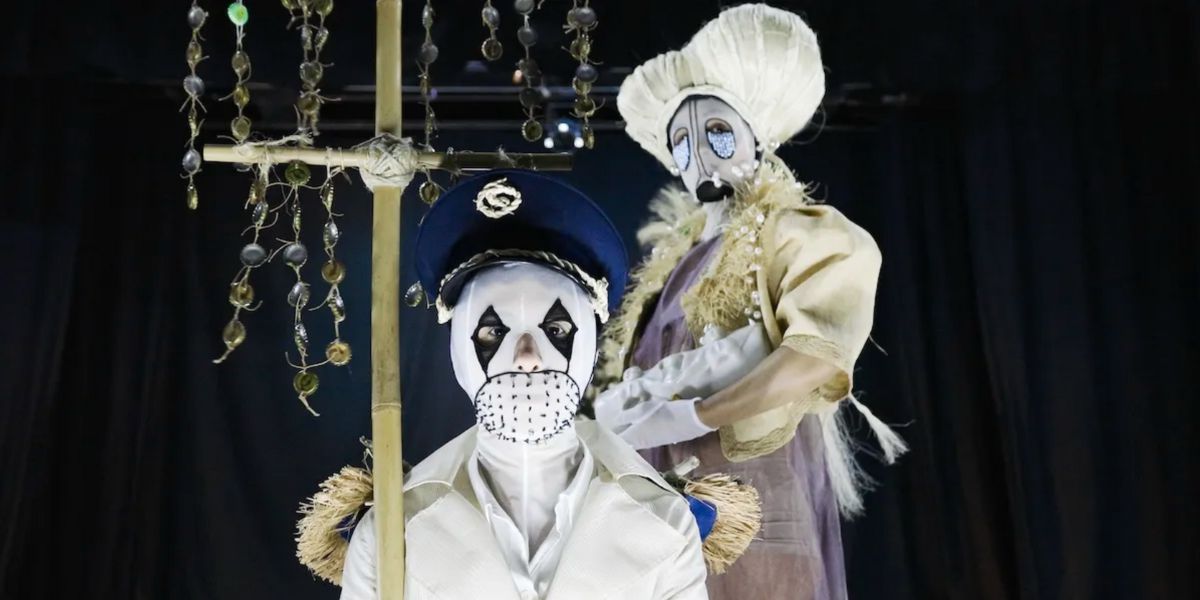
Screening of the work Lugar de consuelo by artist Naufus Ramírez-Figueroa
Date: Saturday, June 24 and Sunday, June 25, 2023
Time: 12:00 p.m.
Format: In-person
Location: Teatro MAMM
Admission is included with the purchase of a ticket to the Museum's exhibition halls.
As part of the exhibition Naufus Ramírez-Figueroa. Cantándole a las plantas, currently on view in our galleries, we will be screening the work Lugar de consuelo, 2020 every Saturday and Sunday in June at the Teatro MAMM at 12 p.m.
Admission is included with the purchase of a ticket to the Museum’s exhibition halls.
About the work
Lugar de consuelo (Place of Solace)
2020
Video performance. Digital video, stereo sound
35’26”
Commissioned for the exhibition The Power Plant, Toronto.
Collaboration with Wingston Gonzalez
Lugar de consuelo is a performance inspired by the staging of the script El corazon del espantapajaros, written by Hugo Carrillo in 1962 and presented in 1975 by a cast of students from the Universidad Popular de Ciudad de Guatemala. The deliberate adaptation that the actors made – agitated by a time of state executions and disappearances – became a denunciation against the government. The students’ work provoked a violent reaction of censorship, death threats, the murder of an actor, and a fire that destroyed the theater, events that occurred after a minister visited one of their performances.
Thinking about this event – with a lost script and actors who remain anonymous to this day – Guatemalan writer Wingston Gonzalez writes a poetic text that serves as the script for Naufus’s performance. In the work, the original characters exist in a fascist context in which they are both villains and victims. In the 1975 presentation, the students (which included Naufus’s uncles) wore street clothes and clown makeup to represent authority figures, but in Ramirez-Figueroa’s piece, the characters wear varied costumes to play the roles of: oligarch, dictator, soldier, cardinal, and scarecrow.
With this video performance, Naufus – who takes on the role of director of the cast – revisits, through the transformation of symbols, the places of personal and social trauma associated with his childhood and his country of birth, wounds that can be traced in other Latin American countries.