Bubuia. Waters as a Source of Imaginations and Desires
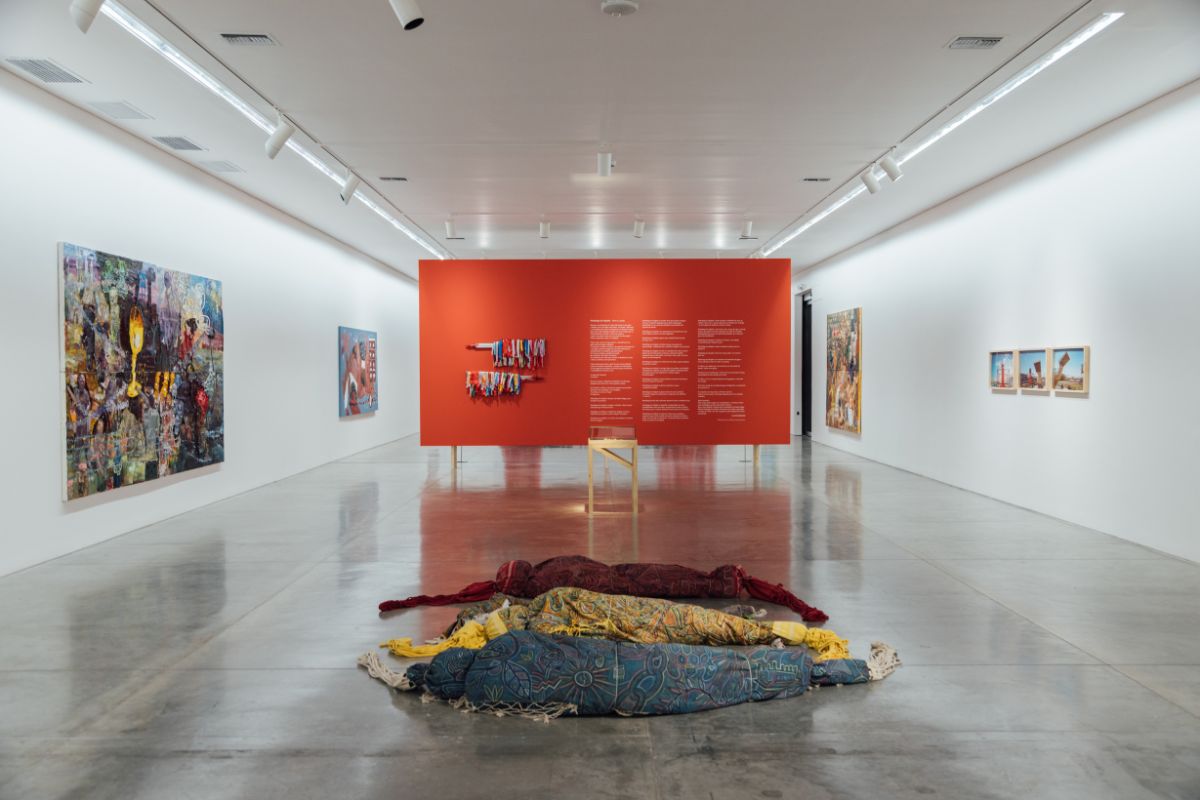
The Amazon is known for its vast forests and diverse fauna and flora, but it is the presence of water — from rainfall and its extensive river network — that shapes the region’s imaginary. Embracing not only the word but also the idea of Bubuia: Waters as a Source of Imaginations and Desires, as the title of the first Bienal das Amazônias, is a celebration of the ethical and cultural relationship between waters and the bodies that move in them, float on them, and let themselves be carried by them. It is an invitation to navigate shifting routes, fluctuating tides, where notions of place, belief, cultural identity, and economic models are profoundly displaced.
Curators: Keyna Eleison and Vânia Leal
Artists: Adriana Varejão, Anna Bella Geiger, Aycoobo, Caio Aguiar (Bonikta), Christie Neptune, Cláudia Andujar, Denilson Baniwa, Duhigó, Éder Oliveira, Elza Lima, Emmanuel Nassar, Francelino Mesquita, Francisco da Silva, Gabriel Bicho, Gê Viana, Gervane de Paula, Gerardo Petsaín, Glicéria Tupinambá, Gustavo Caboco, Hal Wildson, Iwiri-Ki, Joelington Rios, Kelia Sankofa, Kenneth Flijders, Kit-Ling Tjon Pian Gi, Lastenia Canayo, Liça Pataxoop, Lua Cavalcante, Lova Lova, LK PROD, Manauara Clandestina, Marcel Pinas, Marcela Cantuária, Maria José Batista, Miguel Penha, Marinaldo Santos, Miguel Keerveld, Moara Tupinambá, Nay Jinknss, Nancy La Rosa, Noara Quintana, Noemí Pérez, Pablo Mufarrej, PP Condurú, Rafa Bqueer, Rafael Matheus Moreira, René Tosari, Sãnipã, Sandra Brewster, Thiago Martins de Melo, Ueliton Santana, Venuca Evanán, Waleff Dias, Xomatok.
Versión en español
Versão em português
As a key concept, Bubuia is directly inspired by dibubuísmo, a term coined by João de Jesus Paes Loureiro — renowned poet, essayist, playwright, and professor at the Federal University of Pará, born in Abaetetuba, on the banks of the Tocantins River — whose poetic vision began intertwining the real and the imaginary of the Amazon, shaping his vast literary production. Estar de bubuia (floating on the waters) symbolizes a conjunction of movement and stillness, guided by pleasure, reflection, and integration with the natural environment, and speaks volumes about the perseverance and resistance of those who inhabit the region. In this sense, Bubuia is more than a cultural gesture. It is a deliberate predisposition to becoming and to letting things come, established as inherited knowledge — a constituent of riverside caboclo wisdom — orally transmitted as a form of resistance, imbued with knowledge born of a relationship with nature and shared among peers. These relationships raise productive questions for reflecting on ourselves. Thus, a unique cultural system of being and existing in the world emerges, grounded in lived experience. The creative experiences conceived in everyday life are, without a doubt, the essential rhetoric of existence.
In this Amazonian landscape composed of river, forest, and reverie — understood through a dual reality: immediate and mediate — Loureiro affirms that the immediate reality has a logical and objective function. The mediate (which is of interest to us here) serves a magical, enchanting, and aesthetic function. The first edition of the Bienal das Amazônias is, therefore, an invitation to look at this territory through the superimposition of these two realities, as occurs when observing a flowing river: at times the gaze is fixed on the riverbed and its stones, at times on the moving water, and sometimes on both simultaneously.
In the midst of a drastic global climate crisis and growing ideological antagonisms spreading through Brazil and the world, proclaiming the multiplicity of desires as a field of forces that envelops bodies in the Amazonian territory is, above all, a proposal to establish relational spaces that consider the accumulated human experience there — its humanism, its social imaginary. Spaces of self-recognition, of celebration, and, above all, spaces of struggle, resistance, and re-existence for the joy of being plural. Thus, the curatorial core of the Biennale seeks to foster possible connections not only among the nine countries that share the Amazon biome and the aquatic territory of the Amazon River and the nine Brazilian states that make up the Legal Amazon, but also to include the many multifaceted and invisible Amazons that inhabit the contemporary imaginary beyond their physical, social, and geographic boundaries.
Bubuia, in the path proposed by this exhibition, is a strategic position in the face of the full awareness of chaos, violence, and disorder as a method. It is not merely about immersion, but also about the consequences of knowing the unknowns. Bubbles, bathing, pleasure, water, movement, contemplation, river-people, people-river, river-sea, sea-people, riverbanks, river-people-sea in the effervescence of Amazonian cultures. It allows no one to sink into the tides of indifference. It expands, welcoming narratives of enchanted beings, deities, and characters from the infinite cosmologies of the imaginary that emerge from facing the flow of waters.
All the signs and symbols of the rivers are multiple, for the rivers hold equal importance to the peoples who were born and live along their banks and through the paths of these currents that dictate the transfigured force that governs the symbolic exchanges and translations of culture. Bubuiar (to float) is an act of renewal and transformation of the forest spirit that resonates from the heart of the jungle to the world.
Key partner

Institutional partners


Support


Organize