

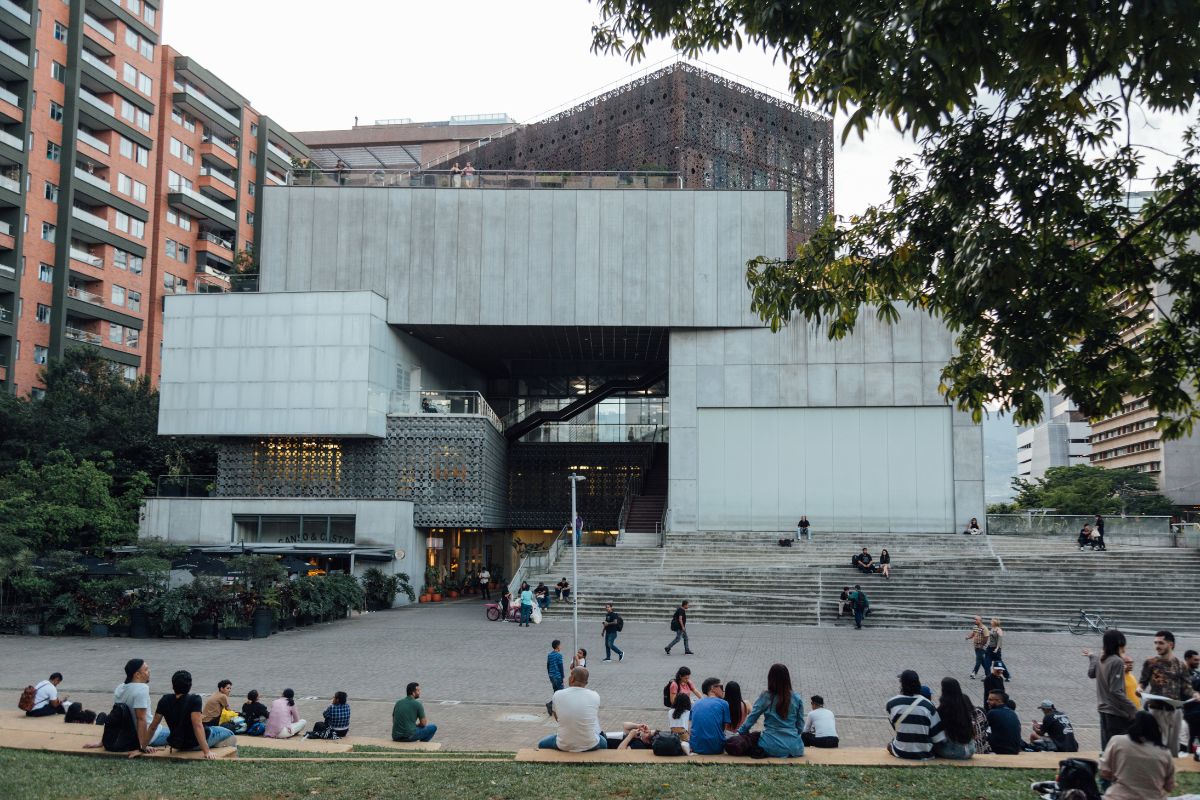
Check our year-end and new year hours to visit us
Start 2025 surrounded by art and cinema
During the months of December and January, the Museo de Arte Moderno de Medellín will have its doors open for you to plan your visit this year-end. In the Museum’s galleries, you will find 7 exhibitions to strengthen your connection with art, which will be open to the public until February 2024, making this an opportunity to discover the work of these artists before their shows close.
El espacio en medio is an exhibition that focuses on Indigenous peoples’ ways of being and engaging with science, astronomy, and the stories of creation, existence, and re-existences, to explore the space between the celestial and the terrestrial, the tangible and the intangible, and what incorporates and weaves the human experience with our living relatives and the beings with whom we share this Earth. This show of international Indigenous artists seeks to bring together works that share concerns and address essential themes in today’s global context, inhabiting in different ways the space in between modernity and Indigenous peoples—whether as neo-colonists, bridges, spokespersons, and/or pioneers of the liberation of aesthetics rooted in their ancestral territories.
Nada se puede duplicar realmente is a solo exhibition by the master Antioquian printmaker Ángela María Restrepo, a key figure in the history of printmaking, drawing, and illustration in Colombia over the last forty years, as well as the founder and owner of the printmaking workshop La Estampa, through which generations of Antioquian printmakers have passed. Restrepo’s work has focused, on one hand, on seemingly trivial aspects of everyday life and, on the other, on the representation of characteristic elements of Antioquian and Colombian flora and landscape, constituting a comprehensive description of her life experience, her context, and her historical moment on Earth.
Khoka Project traces the complex relationship that human beings have woven with the coca plant over time. This species has been demonized and nearly condemned to extinction due to the so-called war on drugs and the inherent prejudice that fails to distinguish the extracted alkaloid, as a psychoactive substance, from the khoka—a medicinal, highly nutritious plant revered as sacred by Indigenous communities and ancient civilizations of South America.
In 1972, the term “non-objectualism” appeared for the first time in the public sphere. The Peruvian critic Juan Acha, who had self-exiled to Mexico City since the end of April, published in November one of his columns in the cultural supplement Diorama of the newspaper Excélsior, giving light to the idea of the non-objectual. Since his last years in Peru, he had been trying to identify the changes in the visual arts following a process of radicalization that sought to break the structures of modernity within the artistic and social reality of Latin America. This attempt to define a complex amalgam of experiences—which at the time were grouped under the banner of the avant-garde—was the starting point for the appearances of non-objectualism throughout the decade, occurring in modulation with different debates on the region’s art scene.
Huellas de aire is an immersive sound installation that explores the relationship between breathing, air, and memory within the context of Medellín’s urban ecology. Conceived as a relational space, the work invites visitors to interact with the sound environment through body movement and breathing, while following movement and interaction cues projected in the room. Inspired by the deep listening practice—developed by the American composer Pauline Oliveros—that Alarcón has embraced in her artistic and research work, this installation seeks to deepen the connection with our shared aerial environment through attentive, embodied listening.
Correspondences is a constantly evolving project between Soundwalk Collective and Patti Smith. Over more than 10 years, it has traversed a vast range of geographies and their natural environments, where the artists have discovered sonic traces left by poets, filmmakers, revolutionaries, and the impact of climate change.
Musa. Perspectivas femeninas en las Colecciones del MAMM y MAC Panamá is an exhibition that brings together works from the collections of the Museo de Arte Moderno de Medellín and the Museo de Arte Contemporáneo de Panamá, seeking to make visible the works of women artists who have historically had less prominence than their male counterparts. The exhibition takes its title from Musa, a video work by the artist Minia Biabiany (Guadeloupe, 1988), which in turn takes the scientific name of the banana plant: musa paradisíaca. Common to the tropical latitudes of the Americas and Asia, its flower is used for medicinal purposes related to uterine ailments, while its fruit has also been central to extractivist processes in the Americas.
Thank you for inhabiting our spaces and for keeping up with our programming in 2024. We want to share these final weeks of the year with you, so here are the updates to our hours for these dates.
End-of-year hours for Museum and MAMM Shop
Tuesday to Friday: 11:00 a.m. to 7:00 p.m.
Saturdays, Sundays, and holidays: 11:00 a.m. to 6:00 p.m.
December 24 and 31: 11:00 a.m. to 4:00 p.m.
December 25 and January 1: closed
Monday, December 30, and Tuesday, January 7: 11:00 a.m. to 7:00 p.m.
The Study Room will be closed from Tuesday, December 3, through Monday, January 6.
Remember that to reach the Museum you can use bus routes that travel along Av. Las Vegas, the Metro Industriales station, and the EnCicla system. Additionally, the Museum has covered parking and in its surroundings offers a varied selection of restaurants and cafes to enjoy.
Parking hours
Monday to Wednesday: 6:30 a.m. to 10:00 p.m.
Thursday and Friday: 6:30 a.m. to 11:59 p.m.
Saturday: 8:00 a.m. to 11:59 p.m.
Sunday: 8:00 a.m. to 10:00 p.m.
Holidays: 8:00 a.m. to 11:59 p.m.
Cine MAMM: an option for spending your days off
As part of the year-end offerings, starting December 18, the Cine MAMM program will run from Wednesday through Sunday, featuring national productions, premieres, and contemporary global cinema.
You can check the Cine MAMM schedule week by week here to plan ahead and buy your tickets.