

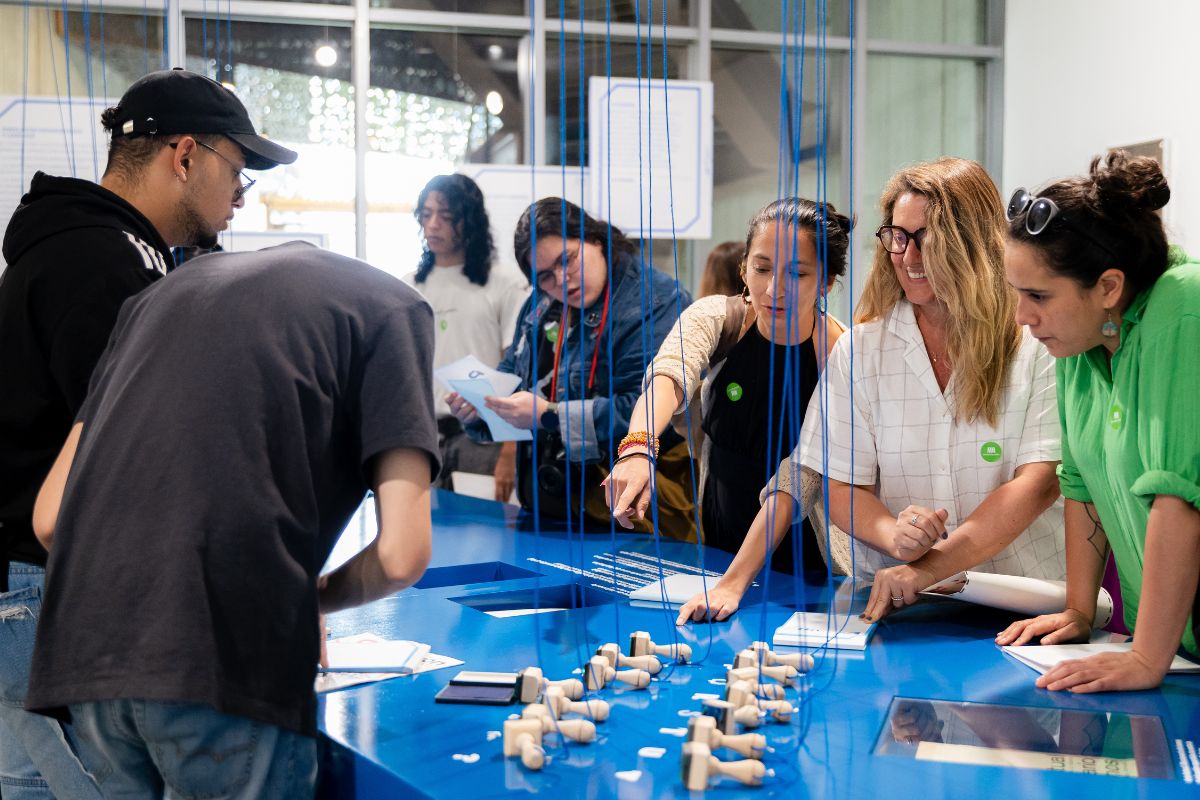
Guided tour with MAMM Mediators
Date: Saturday, September 27, 2025
Time: 3:00 p.m.
Format: In-person
Free admission
Guided tours are spaces accompanied by MAMM Mediators to delve into the context of the exhibitions in our galleries, as well as the artists’ motivations for creating their works.
About the exhibitions
Bubuia. Aguas como fuente de imaginaciones y deseos
The Amazon is known for its vast forested areas and its diversity of fauna and flora, but it is the presence of water — from rainfall and its extensive river network — that shapes the region’s imaginary. Adopting not only the word but also the idea of Bubuia. Aguas como fuente de imaginaciones y deseos as the title of the first Bienal das Amazônias is to celebrate the ethical and cultural relationship between the waters and the bodies that move, float, and let themselves be carried within them. This exhibition is an invitation to travel shifting routes, fluctuating tides, where the notions of place, belief, cultural identity, and economic model are profoundly displaced.
Lleébu. Amazonía colombiana: sonidos y lenguas indígenas en riesgo
Lleébu arises from an essential question: What is lost when a language becomes extinct? The answer transcends the linguistic: unique ways of inhabiting the world disappear, along with collective memories, ancestral knowledge about the territory, and modes of relating to nature. Lleébu — which means “to listen” in the Bora language — embodies an ancestral practice of attentiveness to the surroundings, where listening becomes an act of resonance and care.
Señal abierta. Lenguajes del arte actual
In 1985, artist and cultural manager Leonel Estrada published the Diccionario de Arte Actual, a glossary of art concepts aimed at educating the general public about developing artistic currents. Señal abierta. Lenguajes del arte actual proposes a review of the MAMM collection and documentary archive based on a selection of concepts drawn from the dictionary, which serve to understand the experimental practices developed in the region during the second half of the 20th century. As a precursor to the dictionary, two printed editions were produced: the first prepared by María Isabel Estrada in 1970 and the second, produced as a supplement for the newspaper El Mundo in 1981. Both circulated during the Medellín Art Biennials and served as a pedagogical tool for the public, broadening the interpretation and understanding of the languages, techniques, and artistic currents of the works presented at the biennials.
Khoka Project
The coca plant is a delicate shrub, with red fruits, white flowers, and leaves that vary in shades of green and size; this plant species has adapted and thrived on the Andean slopes, as well as in the tropical forests descending toward the Amazon, on the Caribbean Coast, in the steep mountains of Cauca, Huila, and the Sierra Nevada de Santa Marta in Colombia, as well as in the fertile valleys that cross the coastal desert in Peru and in the lagoons or yungas (mountain forests and jungles) of Bolivia. Coca, alive and free, is exhibited as part of the profound collective and transdisciplinary research Khoka Project, led by artist Susana Mejía.

IMPORTANT NOTICE
We inform our visitors that during exhibition programming and public events, the Museo de Arte Moderno de Medellín may take photographic, video, and/or audiovisual recordings that could include the image of attendees.
These recordings will be used for institutional outreach, promotion of cultural activities, and documentation of the Museum’s cultural activities, within the framework of its legal functions. Their handling will be carried out in accordance with current personal data protection policies and the guidelines established by the entity.